A1494312
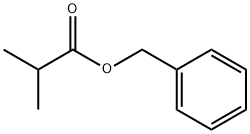
Benzyl Isobutyrate , >98.0%(GC) , 103-28-6
Synonym(s):
Benzyl-2-methyl propionate
CAS NO.:103-28-6
Empirical Formula: C11H14O2
Molecular Weight: 178.23
MDL number: MFCD00048315
EINECS: 203-095-9
| Pack Size | Price | Stock | Quantity |
| 25G | RMB103.20 | In Stock |
|
| 50g | RMB159.20 | In Stock |
|
| 100G | RMB255.20 | In Stock |
|
| 250g | RMB479.20 | In Stock |
|
| others | Enquire |
Update time: 2022-07-08
PRODUCT Properties
| Boiling point: | 238 °C(lit.) |
| Density | 1.003 g/mL at 25 °C(lit.) |
| vapor pressure | 5.7Pa at 25℃ |
| refractive index | n |
| FEMA | 2141 | BENZYL ISOBUTYRATE |
| Flash point: | 138 °F |
| storage temp. | Store at room temperature, keep dry and cool |
| form | clear liquid |
| color | Colorless to Almost colorless |
| Odor | at 100.00 %. jasmin oily fruity sweet rose tropical |
| Odor Type | floral |
| biological source | synthetic |
| Water Solubility | 989.48mg/L at 25℃ |
| JECFA Number | 844 |
| BRN | 1869299 |
| LogP | 2.99 at 25℃ |
| CAS DataBase Reference | 103-28-6(CAS DataBase Reference) |
| NIST Chemistry Reference | Propanoic acid, 2-methyl-, phenylmethyl ester(103-28-6) |
| EPA Substance Registry System | Propanoic acid, 2-methyl-, phenylmethyl ester (103-28-6) |
Description and Uses
Useful in fruity-spicy-herbaceous fragrance types, in Gardenia, Jasmin, Rose bases, etc., in trace amounts or in higher concentration if used as a modifier for Benzyl acetate. Occasionally used in flavour compositions, mainly in imitation Banana, Raspberry, Strawberry, and in “Tutti-frutti” flavour. Concentrations are usually about 25 ppm in the finished product.
Safety
| Symbol(GHS) |  GHS02 |
| Signal word | Warning |
| Hazard statements | H303 |
| Precautionary statements | P270-P301+P312-P403-P501c |
| Risk Statements | 10 |
| Safety Statements | 16-24/25 |
| RIDADR | UN 3272 3/PG 3 |
| WGK Germany | 1 |
| RTECS | NQ4550000 |
| TSCA | Yes |
| HS Code | 29156000 |
| Toxicity | The acute oral LD50 in rats was found to be 2850 mg/kg. The acute dermal LD50 was reported to be > 5 ml/kg in the rabbit |