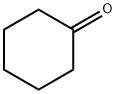
Cyclohexanone , ACS,≥99.0% , 108-94-1
Synonym(s):
Cyclohexanone;Pimelic ketone
CAS NO.:108-94-1
Empirical Formula: C6H10O
Molecular Weight: 98.14
MDL number: MFCD00001625
EINECS: 203-631-1
PRODUCT Properties
| Melting point: | -47 °C (lit.) |
| Boiling point: | 155 °C (lit.) |
| Density | 0.947 g/mL at 25 °C (lit.) |
| vapor density | 3.4 (vs air) |
| vapor pressure | 3.4 mm Hg ( 20 °C) |
| refractive index | n |
| FEMA | 3909 | CYCLOHEXANONE |
| Flash point: | 116 °F |
| storage temp. | Store at +5°C to +30°C. |
| solubility | 90g/l |
| pka | 17(at 25℃) |
| form | Liquid |
| color | APHA: ≤10 |
| Relative polarity | 0.281 |
| PH | 7 (70g/l, H2O, 20℃) |
| Odor | Like peppermint and acetone. |
| explosive limit | 1.1%, 100°F |
| Odor Type | minty |
| biological source | synthetic |
| Water Solubility | 150 g/L (10 ºC) |
| Merck | 14,2726 |
| JECFA Number | 1100 |
| BRN | 385735 |
| Henry's Law Constant | 1.2 x 10⁻⁵ atm?m3/mol at 25 °C (Hawthorne et al., 1985)
6.92 x 10⁻⁵ atm?m3/mol at 60.00 °C, 10.7 at 70.00 °C, 16.4 at 80.00 °C (headspace-GC, Hovorka et al., 2002) |
| Exposure limits | TLV-TWA 100 mg/m3 (25 ppm) (ACGIH);
IDLH 5000 ppm (NIOSH). |
| Dielectric constant | 18.2(20℃) |
| Stability: | Stable. Combustible. Incompatible with strong oxidizing agents. |
| LogP | 0.86 at 25℃ |
| Surface tension | 33.74mN/m at 298.15K |
| CAS DataBase Reference | 108-94-1(CAS DataBase Reference) |
| IARC | 3 (Vol. 47, 71) 1999 |
| NIST Chemistry Reference | Cyclohexanone(108-94-1) |
| EPA Substance Registry System | Cyclohexanone (108-94-1) |
Description and Uses
Cyclohexanone, a colorless liquid is a cyclic ketone. It is an important building block for the synthesis of a variety of organic compounds. Majority of the cyclohexanone synthesized is utilized as an intermediate in the synthesis of nylon.
Used as a polyvinyl chloride (PVC) solvent, cyclohexanone caused contact dermatitis in a woman manufacturing PVC fluidotherapy bags. Cyclohexanone probably does not cross react with cyclohexanone resin. A cyclohexanone-derived resin used in paints and varnishes caused contact dermatitis in painters.
Cyclohexanone is used in the productionof adipic acid for making nylon; in thepreparation of cyclohexanone resins; and asa solvent for nitrocellulose, cellulose acetate,resins, fats, waxes, shellac, rubber, and DDT..
Safety
| Symbol(GHS) |    GHS02,GHS05,GHS07 |
| Signal word | Danger |
| Hazard statements | H226-H302+H312+H332-H315-H318 |
| Precautionary statements | P210-P280-P301+P312-P303+P361+P353-P304+P340+P312-P305+P351+P338 |
| Hazard Codes | Xn |
| Risk Statements | 10-20-41-38-20/21/22 |
| Safety Statements | 25-36/37/39-26 |
| RIDADR | UN 1915 3/PG 3 |
| OEB | A |
| OEL | TWA: 25 ppm (100 mg/m3) [skin] |
| WGK Germany | 1 |
| RTECS | GW1050000 |
| Autoignition Temperature | 788 °F |
| TSCA | Yes |
| HS Code | 2914 22 00 |
| HazardClass | 3 |
| PackingGroup | III |
| Hazardous Substances Data | 108-94-1(Hazardous Substances Data) |
| Toxicity | LD50 orally in rats: 1.62 ml/kg (Smyth) |
| IDLA | 700 ppm |
| Limited Quantities | 5.0 L (1.3 gallons) (liquid) |
| Excepted Quantities | Max Inner Pack (30g or 30ml) and Max Outer Pack (1Kg or 1L) |