
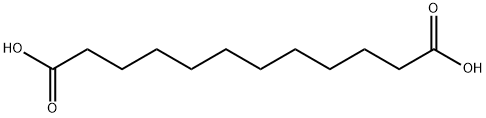
PRODUCT Properties
| Melting point: | 127-129 °C (lit.) |
| Boiling point: | 245 °C/10 mmHg (lit.) |
| Density | 1,15 g/cm3 |
| vapor pressure | 21 mm Hg ( 222 °C) |
| RTECS | JR2370000 |
| refractive index | 1.4437 (estimate) |
| Flash point: | 220 °C |
| storage temp. | Sealed in dry,Room Temperature |
| solubility | ethanol: 0.1 g/mL, clear |
| pka | 4.48±0.10(Predicted) |
| form | Pellets or Powder |
| color | White |
| PH | 5 (H2O, 20℃)(aqueous suspension) |
| Water Solubility | < 0.1 g/L (20 ºC) |
| Sensitive | Air Sensitive |
| BRN | 1782580 |
| Stability: | Stable. Incompatible with strong oxidizing agents, reducing agents. Combustible. |
| InChIKey | CXMXRPHRNRROMY-UHFFFAOYSA-N |
| LogP | 3.2 at 25℃ |
| CAS DataBase Reference | 693-23-2(CAS DataBase Reference) |
| NIST Chemistry Reference | Dodecanedioic acid(693-23-2) |
| EPA Substance Registry System | Dodecanedioic acid (693-23-2) |
Description and Uses
This acid is used in the production of nylon (nylon - 6,12), polyamides, coatings, adhesives, greases, polyesters, dyestuffs, detergents, flame retardants, and fragrances. It is now produced by fermentation of long-chain alkanes with a specific strain of Candida tropicalis. Its monounsaturated analogue (traumatic acid) is described below.
Induced mutation of dodecanedioic acid producing Candida tropicalis.
Safety
| Symbol(GHS) |  GHS07 |
| Signal word | Warning |
| Hazard statements | H319 |
| Precautionary statements | P264-P280-P305+P351+P338-P337+P313 |
| Hazard Codes | Xi |
| Risk Statements | 36/37/38-36 |
| Safety Statements | 26-36-24/25 |
| WGK Germany | - |
| TSCA | Yes |
| HS Code | 29171990 |
| Hazardous Substances Data | 693-23-2(Hazardous Substances Data) |
