PRODUCT Properties
| Melting point: | 130-131° |
| alpha | D15 -43° (alc) |
| Boiling point: | 473.76°C (rough estimate) |
| Density | 1.0909 (rough estimate) |
| refractive index | 1.5614 (estimate) |
| pka | 14.34±0.20(Predicted) |
| optical activity | -4315 (c1, ethanol) |
| InChI | InChI=1S/C22H27NO2/c1-23-19(15-21(24)17-9-4-2-5-10-17)13-8-14-20(23)16-22(25)18-11-6-3-7-12-18/h2-7,9-12,19-21,24H,8,13-16H2,1H3/t19-,20+,21-/m0/s1 |
| InChIKey | MXYUKLILVYORSK-HBMCJLEFSA-N |
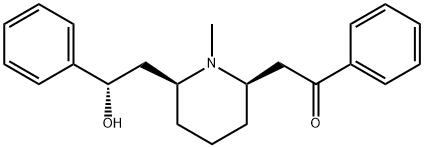
| SMILES | C(=O)(C1=CC=CC=C1)C[C@H]1CCC[C@@H](C[C@H](O)C2=CC=CC=C2)N1C |
Description and Uses
Lobeline is mainly present in Lobelia chinensis, Lobelia inflata, Campanula medium, Lobelia hassleri, and Lobelia nicotianaefolia . Lobelia inflata has also been considered as an Indian tobacco and has been used for the treatment of respiratory diseases for a long history. It was also a treatment of asthma by American Aborigines. In the United States during the nineteenth century, doctors use Lobelia inflata as a vomiting agent, to remove the poison from the body. It is also called “vomit grass.” Now Lobelia inflata is still used to clear throat, bronchial, lung, and other respiratory mucus .
Lobeline is the principal lobelia alkaloid.It occurs in the seeds and herb of Indiantobacco (Lobelia inflata and Lobeliaceae). Itis used as a respiratory stimulant. Its sulfatesalt is used in antismoking tablets.
Safety
| Symbol(GHS) |  GHS06 |
| Signal word | Danger |
| Hazard statements | H301+H311+H331 |
| Hazard Codes | T |
| Risk Statements | 23/24/25 |
| Safety Statements | 36/37/39-45 |
| RIDADR | 1544 |
| HazardClass | 6.1(b) |
| PackingGroup | III |