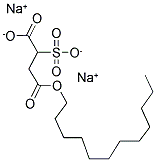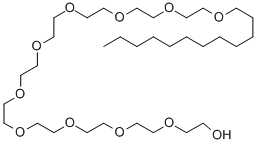
Anapoe-C12E10 , Averagemw.627,10%aquatic solution , 6540-99-4
Synonym(s):
C12E10;Polyoxyethylene (10) lauryl ether
| Pack Size | Price | Stock | Quantity |
| 5×10ml | RMB1007.20 | In Stock |
|
| 50×1ml | RMB1199.20 | In Stock |
|
| others | Enquire |
PRODUCT Properties
| Cosmetics Ingredients Functions | SURFACTANT - CLEANSING SURFACTANT - EMULSIFYING |
| Cosmetic Ingredient Review (CIR) | POLYOXYETHYLENE 10 LAURYL ETHER (6540-99-4) |
| InChI | InChI=1S/C32H66O11/c1-2-3-4-5-6-7-8-9-10-11-13-34-15-17-36-19-21-38-23-25-40-27-29-42-31-32-43-30-28-41-26-24-39-22-20-37-18-16-35-14-12-33/h33H,2-32H2,1H3 |
| InChIKey | KOMQWDINDMFMPD-UHFFFAOYSA-N |
| SMILES | O(CCOCCOCCOCCOCCOCCOCCO)CCOCCOCCOCCCCCCCCCCCC |
| LogP | 1.820 (est) |
Description and Uses
POLYOXYETHYLENE 10 LAURYL ETHER (also known as 3,6,9,12,15,18,21,24,27,30-Decaoxadotetracontan-1-ol, POLE) is a biodegradable non-ionic surfactant that can be used as an effective corrosion inhibitor and extraction agent. In a 2 M hydrochloric acid solution, POLE spontaneously adsorbs onto the surface of 316 stainless steel via the ethylene oxide units in its molecule, forming a protective film that effectively reduces the corrosion rate of the stainless steel and inhibits the occurrence of pitting corrosion [1]. Furthermore, POLE can serve as a substitute for traditional, toxic organic solvents. It is used to extract polychlorinated dibenzo-p-dioxins (PCDDs) from marine sediment samples [2].