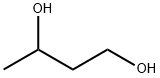
(±)-1,3-Butanediol , Analysis standard , 107-88-0
Synonym(s):
(±)-1,3-Butanediol;1,3-Butylene glycol
CAS NO.:107-88-0
Empirical Formula: C4H10O2
Molecular Weight: 90.12
MDL number: MFCD00004554
EINECS: 203-529-7
| Pack Size | Price | Stock | Quantity |
| 250MG | RMB318.40 | In Stock |
|
| others | Enquire |
PRODUCT Properties
| Melting point: | -54 °C |
| Boiling point: | 203-204 °C(lit.) |
| Density | 1.005 g/mL at 25 °C(lit.) |
| vapor density | 3.1 (20 °C, vs air) |
| vapor pressure | 0.06 mm Hg ( 20 °C) |
| refractive index | n |
| Flash point: | 250 °F |
| storage temp. | Store below +30°C. |
| solubility | >500g/lMiscible |
| form | Liquid |
| pka | 14.83±0.20(Predicted) |
| Specific Gravity | 1.004 – 1.007 |
| color | Clear colorless to yellow, may discolor to brown on storage |
| PH | 6.1 (500g/l, H2O, 20℃) |
| PH Range | 6 - 7 at 20 °C |
| Odor | odorless |
| explosive limit | 1.9-12.6%(V) |
| Water Solubility | SOLUBLE |
| Sensitive | Hygroscopic |
| Merck | 14,1567 |
| BRN | 1731276 |
| Henry's Law Constant | 7.0×10³ mol/(m3Pa) at 25℃, Burkholder et al. (2019) |
| Stability: | Stable. Flammable. Hygroscopic - protect from air and moisture. Incompatible with strong oxidizing agents. |
| Cosmetics Ingredients Functions | SKIN CONDITIONING SOLVENT VISCOSITY CONTROLLING HUMECTANT FRAGRANCE |
| InChI | 1S/C4H10O2/c1-4(6)2-3-5/h4-6H,2-3H2,1H3 |
| InChIKey | PUPZLCDOIYMWBV-UHFFFAOYSA-N |
| SMILES | CC(O)CCO |
| LogP | -0.9 at 25℃ |
| CAS DataBase Reference | 107-88-0(CAS DataBase Reference) |
| NIST Chemistry Reference | 1,3-Butanediol(107-88-0) |
| EPA Substance Registry System | 1,3-Butylene glycol (107-88-0) |
Description and Uses
1,3-Butanediol(also known as 1,3-Butylene Glycol or Butylene glycol) is a viscous, colorless, transparent liquid with a boiling point of 208°C and a faint odor. It exhibits the reactivity of a diol and possesses excellent chemical stability. Currently, 1,3-Butanediol is predominantly used in the cosmetics industry as a humectant, thanks to its excellent antibacterial properties and lower irritation and allergenicity compared to glycerol and propylene glycol. In the chemical industry, it is used to synthesize various resins, improve their properties, and enhance dyeability. As a solvent, 1,3-Butanediol is used in the manufacture of coatings, adhesives, and other chemical products. It is a key raw material in the production of polyester and polyether polyols, which are polymers used to manufacture polyurethane foams, elastomers, and coatings, among others. In the pharmaceutical industry, 1,3-Butanediol serves as a key intermediate in the synthesis of various drug molecules, including antibiotics, antiviral drugs, and anticancer agents. During drug preparation, it acts as a solvent, helping to improve the solubility and stability of active pharmaceutical ingredients.
Its most extensive use is as an intermediate in the manufacture of polyester plasticisers and other chemical products. It finds some use as a solvent and humectant, a useful chemical intermediate. It has extensive application in the manufacture of structural materials for boats, custom mouldings, and sheets and boards for construction applications. 1,3-Butanediol imparts resistance to weathering plus flexibility and impact resistance. It is also used in the manufacture of saturated polyesters for polyurethane coatings, where the glycol imparts greater flexibility to the polyester molecule. 1,3-Butanediol is currently used in many personal care products.
Safety
| Symbol(GHS) |  GHS07 |
| Signal word | Warning |
| Hazard statements | H319 |
| Precautionary statements | P264-P280-P305+P351+P338-P337+P313 |
| PPE | Eyeshields, Gloves, multi-purpose combination respirator cartridge (US) |
| Safety Statements | 24/25 |
| WGK Germany | 1 |
| RTECS | EK0440000 |
| F | 3 |
| Autoignition Temperature | 741 °F |
| TSCA | TSCA listed |
| HS Code | 29053920 |
| Storage Class | 10 - Combustible liquids |
| Hazardous Substances Data | 107-88-0(Hazardous Substances Data) |
| Toxicity | LD50 orally in Rabbit: 18610 mg/kg LD50 dermal Rabbit > 20000 mg/kg |
| REACH Registrations | Active |