A1341850
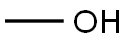
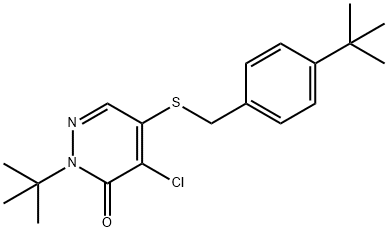
PyridabeninMethanol , 100μg/mL , 96489-71-3
CAS NO.:96489-71-3
Empirical Formula: C19H25ClN2OS
Molecular Weight: 364.93
MDL number: MFCD00274601
EINECS: 405-700-3
| Pack Size | Price | Stock | Quantity |
| 1.2ml | RMB103.20 | In Stock |
|
| others | Enquire |
Update time: 2022-07-08
PRODUCT Properties
| Melting point: | 111-112° |
| Boiling point: | 429.9±55.0 °C(Predicted) |
| Density | 1.2 g/cm3 |
| storage temp. | 0-6°C |
| solubility | Chloroform: Slightly Soluble |
| form | Solid |
| pka | -2.69±0.20(Predicted) |
| color | Off-white to light yellow |
| Merck | 13,8057 |
| BRN | 7933972 |
| Henry's Law Constant | 2.1×10⁻¹ mol/(m3Pa) at 25℃, HSDB (2015) |
| Major Application | agriculture environmental |
| InChI | InChI=1S/C19H25ClN2OS/c1-18(2,3)14-9-7-13(8-10-14)12-24-15-11-21-22(19(4,5)6)17(23)16(15)20/h7-11H,12H2,1-6H3 |
| InChIKey | DWFZBUWUXWZWKD-UHFFFAOYSA-N |
| SMILES | C1(=O)N(C(C)(C)C)N=CC(SCC2=CC=C(C(C)(C)C)C=C2)=C1Cl |
| LogP | 6.370 |
| CAS DataBase Reference | 96489-71-3(CAS DataBase Reference) |
| NIST Chemistry Reference | Pyridaben(96489-71-3) |
| EPA Substance Registry System | Pyridaben (96489-71-3) |
Description and Uses
Pyridaben is an insecticide and acaricide. It has a low aqueous solubility, relatively volatile and, based on its chemical properties, is not expected to leach to groundwater. It tends not to persist in soils or water systems. It is moderately toxic to mammals and not expected to bioaccumulate. It is highly toxic to most aquatic organisms and honeybees but less so to earthworms and birds.
Pyridaben is a pyridazinone derivative used as an acaricide.
Safety
| Symbol(GHS) |   GHS06,GHS09 |
| Signal word | Danger |
| Hazard statements | H301+H331-H410 |
| Precautionary statements | P261-P264-P270-P273-P301+P310-P304+P340+P311 |
| PPE | Eyeshields, Faceshields, Gloves, type P2 (EN 143) respirator cartridges |
| Hazard Codes | T;N,N,T |
| Risk Statements | 23/25-50/53 |
| Safety Statements | 36/37-45-60-61 |
| RIDADR | UN 3077 |
| WGK Germany | 3 |
| RTECS | UR6149000 |
| HazardClass | 6.1(a) |
| PackingGroup | II |
| Storage Class | 6.1C - Combustible acute toxic Cat.3 toxic compounds or compounds which causing chronic effects |
| Hazard Classifications | Acute Tox. 3 Inhalation Acute Tox. 3 Oral Aquatic Acute 1 Aquatic Chronic 1 |
| Hazardous Substances Data | 96489-71-3(Hazardous Substances Data) |
| Toxicity | LD50 in male, female rats, bobwhite quail, mallard ducks (mg/kg): 435, 358, >2250, >2500 orally (Hirata); LD50 in male, female rabbits (mg/kg): >2000, >2000 dermally (Hirata) |
| REACH Registrations | Inactive |