A2323812
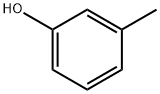
m-Cresol , >99.0%(GC) , 108-39-4
Synonym(s):
m-Cresol;3-Methylphenol;m-Cresol;m-Cresol solution;1-Hydroxy-3-methylbenzene
CAS NO.:108-39-4
Empirical Formula: C7H8O
Molecular Weight: 108.14
MDL number: MFCD00002302
EINECS: 203-577-9
Update time: 2022-07-08
PRODUCT Properties
| Melting point: | 8-10 °C(lit.) |
| Boiling point: | 203 °C(lit.) |
| Density | 1.034 g/mL at 25 °C(lit.) |
| vapor density | 3.72 (vs air) |
| vapor pressure | <1 mm Hg ( 20 °C) |
| FEMA | 3530 | M-CRESOL |
| refractive index | n |
| Flash point: | 187 °F |
| storage temp. | Store below +30°C. |
| solubility | 23.5g/l; Soluble 2 % in water, soluble in alcohol and oils. |
| pka | 10.01(at 25℃) |
| form | Liquid |
| color | Clear colorless to slight red |
| PH | 5 (20g/l, H2O, 20℃) |
| Odor | Dry-tarry, medicinal-leathery odor |
| Odor Type | phenolic |
| biological source | synthetic |
| explosive limit | 1.06-1.35%, 150°F |
| Odor Threshold | 0.0001ppm |
| Water Solubility | 20 g/L (20 ºC) |
| Thermal Conductivity | 0.149 W/(m·K) at 25 ℃ |
| Specific Heat Capacity | Cp(liquid): 2.08 J/(g·K), at 25℃ |
| λmax | 273nm(lit.) |
| Merck | 14,2579 |
| JECFA Number | 692 |
| BRN | 506719 |
| Henry's Law Constant | 1.2×101 mol/(m3Pa) at 25℃, Brockbank (2013) |
| Exposure limits | ACGIH TLV-TWA:20 mg/m3,Inhalable fraction and vapor NIOSH REL-TWA:2.3 ppm(10 mg/m3);IDLH:250 ppm |
| Dielectric constant | 11.5 |
| Stability: | Stable. Combustible. Incompatible with strong oxidizing agents, strong bases, strong acids, aluminium, aluminium alloys. Air and light sensitive. Hygroscopic. |
| Cosmetics Ingredients Functions | PERFUMING ANTIMICROBIAL |
| Cosmetic Ingredient Review (CIR) | m-Cresol (108-39-4) |
| InChI | 1S/C7H8O/c1-6-3-2-4-7(8)5-6/h2-5,8H,1H3 |
| InChIKey | RLSSMJSEOOYNOY-UHFFFAOYSA-N |
| SMILES | Cc1cccc(O)c1 |
| LogP | 1.96 |
| Surface tension | 34.57mN/m at 298.15K |
| CAS DataBase Reference | 108-39-4(CAS DataBase Reference) |
| NIST Chemistry Reference | Phenol, 3-methyl-(108-39-4) |
| EPA Substance Registry System | m-Cresol (108-39-4) |
Description and Uses
m-Cresol is employed in the preparation of synthetic resins like phenol-formaldehyde resins, disinfectants, and photographic developers. It is used as industrial solvent for dissolving polymers such as polyaniline. It acts as a precursor to vitamin E and antiseptic amylmetacresol. It is used as insuline preservatives.
Safety
| Symbol(GHS) |    GHS05,GHS06,GHS08 |
| Signal word | Danger |
| Hazard statements | H301+H311-H314-H370-H372-H373-H351-H401-H227 |
| Precautionary statements | P501-P273-P270-P202-P260-P210-P201-P264-P280-P370+P378-P308+P311-P361+P364-P303+P361+P353-P301+P330+P331-P301+P310+P330-P304+P340+P310-P305+P351+P338+P310-P403+P235-P405 |
| Hazard Codes | T |
| Risk Statements | 24/25-34-39/23/24/25-23/24/25 |
| Safety Statements | 36/37/39-45-36/37 |
| RIDADR | UN 2076 6.1/PG 2 |
| OEB | B |
| OEL | TWA: 2.3 ppm (10 mg/m3) |
| WGK Germany | 1 |
| RTECS | GO6125000 |
| F | 8 |
| Autoignition Temperature | 626 °C |
| TSCA | TSCA listed |
| HazardClass | 6.1 |
| PackingGroup | II |
| HS Code | 29071200 |
| Storage Class | 6.1A - Combustible acute toxic Cat. 1 and 2 very toxic hazardous materials |
| Hazard Classifications | Acute Tox. 3 Dermal Acute Tox. 3 Oral Aquatic Chronic 3 Eye Dam. 1 Skin Corr. 1B |
| Hazardous Substances Data | 108-39-4(Hazardous Substances Data) |
| Toxicity | LD50 orally in rats: 2.02 g/kg (Deichmann, Witherup) |
| REACH Registrations | Active |
| Limited Quantities | 100ml (liquid) or 0.5 Kg (solid) |
| Excepted Quantities | Max Inner Pack (1g or 1ml) and Max Outer Pack (500g or 500ml) |