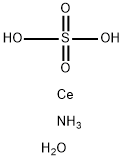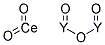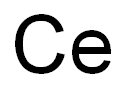
Cerium , Ingots, 1-10mm, stored in oil, 99.5%metalsbasis , 7440-45-1
Synonym(s):
;Cerium
CAS NO.:7440-45-1
Empirical Formula: Ce
Molecular Weight: 140.116
MDL number: MFCD00010924
EINECS: 231-154-9
PRODUCT Properties
| Melting point: | 795 °C (lit.) |
| Boiling point: | 3443 °C (lit.) |
| Density | 6.67 g/mL at 25 °C (lit.) |
| solubility | soluble in dilute acid solutions |
| form | powder |
| Specific Gravity | 6.9 |
| color | Silver-gray |
| Flame Color | Yellow |
| Resistivity | 73 μΩ-cm, 20°C |
| Water Solubility | soluble dilute mineral acids [KIR78] |
| Electrical Conductivity | 1.4× 10⁶S/m |
| Thermal Conductivity | 11 W/(m·K) |
| Specific Heat Capacity | Cp(crystal): 0.19 J/(g·K); Cp(gas): 0.16 J/(g·K), at 25℃ |
| Sensitive | Air & Moisture Sensitive |
| Merck | 13,2003 |
| Exposure limits | ACGIH: TWA 2 ppm; STEL 4 ppm OSHA: TWA 2 ppm(5 mg/m3) NIOSH: IDLH 25 ppm; TWA 2 ppm(5 mg/m3); STEL 4 ppm(10 mg/m3) |
| InChI | 1S/Ce |
| InChIKey | GWXLDORMOJMVQZ-UHFFFAOYSA-N |
| SMILES | [Ce] |
| Bulk Modulus | 21.5 GPa |
| Hardness, Vickers | 24 |
| Modulus of Elasticity | 41.4 GPa |
| Poissons Ratio | 0.248 |
| Shear Modulus | 13.5 GPa |
| CAS DataBase Reference | 7440-45-1(CAS DataBase Reference) |
| EPA Substance Registry System | Cerium (7440-45-1) |
Description and Uses
Cerium is a rare earth metal and the most abundant member of the lanthanide series discovered by Jons J. Berzelius and W. von Hisinger in 1803 in Sweden. Berzelius and Hisinger discovered the new element in a rare reddish-brown mineral now known as cerite, a cerium–lanthanide silicate. Although they could not isolate the pure metal, they found that cerium had two oxidation states: trivalent state (Ce3+, cerous, usually orangered) and the tetravalent state (Ce4+, ceric, usually colorless). Cerium is the only material known to have a solid-state critical point.
In metallurgy as stabilizers in alloys and as an alternative to thorium oxide in welding electrodes. In glass as polishing agent, decolorizer to stabilize impurities, to render glass opaque to near uv radiation, to resist discoloration from strong light or high energy electron bombardment (as in television screens). In ceramics as an opacifying and strengthening agent. Catalysts to impart high cracking activity for crude oil processing, in automotive exhaust control devices, as combustion additive, polymerization initiator, paint drier, polymer stabilizer. As phosphor in fluorescent lamps, cathode ray tubes and thorium dioxide gas mantles.
Safety
| Symbol(GHS) |  GHS02 |
| Signal word | Danger |
| Hazard statements | H228 |
| Precautionary statements | P210-P240-P241-P280-P370+P378 |
| Hazard Codes | C,Xn,F |
| Risk Statements | 22-23-36/38-36/37/38-20/21/22-11-15-14/15 |
| Safety Statements | 26-36-36/37/39-16-43 |
| RIDADR | UN 1333 4.1/PG II (CERIUM, slabs, ingots or rods) |
| RIDADR | UN 3078 4.3/PG II (CERIUM, turnings or gritty powder) |
| WGK Germany | 3 |
| F | 10 |
| TSCA | TSCA listed |
| HazardClass | 4.1 |
| PackingGroup | II |
| HS Code | 28053090 |
| Storage Class | 4.1B - Flammable solid hazardous materials |
| Hazard Classifications | Flam. Sol. 1 |
| REACH Registrations | Active |