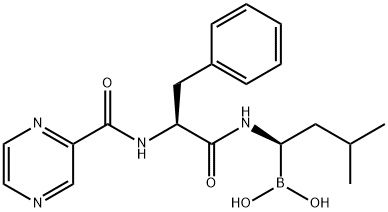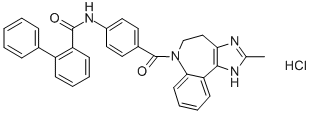
Conivaptan HCl , ≥99% , 168626-94-6
CAS NO.:168626-94-6
Empirical Formula: C32H26N4O2.HCl
Molecular Weight: 535.04
MDL number: MFCD00945712
EINECS: 1312995-182-4
| Pack Size | Price | Stock | Quantity |
| 10MG | RMB307.20 | In Stock |
|
| 50MG | RMB1004.00 | In Stock |
|
| 250MG | RMB5584.00 | In Stock |
|
| others | Enquire |
PRODUCT Properties
| Melting point: | >250° |
| storage temp. | under inert gas (nitrogen or Argon) at 2-8°C |
| solubility | DMSO (Slightly), Methanol (Slightly) |
| form | Solid |
| color | White to Off-White |
| InChIKey | BTYHAFSDANBVMJ-UHFFFAOYSA-N |
| SMILES | C12=CC=CC=C1N(CCC1N=C(C)NC2=1)C(=O)C1=CC=C(NC(=O)C2C=CC=CC=2C2=CC=CC=C2)C=C1.Cl |
Description and Uses
Conivaptan is an antagonist of the arginine vasopressin (AVP) receptors V1A and V2 (Kis = 0.48 and 3.04 nM for rat liver V1A and kidney V2, respectively). It also competitively inhibits oxytocin binding to rat uterine oxytocin receptors (Ki = 44 nM) but has no effect on AVP binding to anterior pituitary V1B receptors at concentrations up to 100 μM in a radioligand binding assay. Conivaptan suppresses AVP-induced increases in intracellular calcium in vascular smooth muscle cells (VSMCs) in vitro and the pressor response in pithed rats. Conivaptan (0.01-0.3 mg/kg, i.v.) increases urine output and decreases urine osmolality in dehydrated conscious rats in a dose-dependent manner. It also reduces brain edema and blood-brain barrier disruption in a mouse experimental stroke model.
Used in treatment of congestive heart failure.
Safety
| Symbol(GHS) |  GHS07 |
| Signal word | Warning |
| Hazard statements | H302 |
| Precautionary statements | P501-P270-P264-P301+P312+P330 |