A2501112
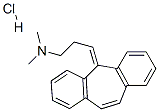
Cyclobenzaprine hydrochloride , 98% , 6202-23-9
Synonym(s):
5-(3-Dimethylaminopropylidene)dibenzo[a,e]cycloheptatriene hydrochloride;Cyclobenzaprine hydrochloride
CAS NO.:6202-23-9
Empirical Formula: C20H22ClN
Molecular Weight: 311.85
MDL number: MFCD00079039
EINECS: 228-264-4
| Pack Size | Price | Stock | Quantity |
| 1G | RMB263.20 | In Stock |
|
| 5G | RMB820.80 | In Stock |
|
| 25G | RMB3519.20 | In Stock |
|
| others | Enquire |
Update time: 2022-07-08
PRODUCT Properties
| Melting point: | 216-2180C |
| Flash point: | 9℃ |
| storage temp. | Inert atmosphere,Room Temperature |
| Water Solubility | Completely soluble in water |
| solubility | ≥15.59 mg/mL in DMSO; ≥5.32 mg/mL in EtOH; ≥54.3 mg/mL in H2O |
| form | Solid |
| color | White to Almost white |
| λmax | 290nm(lit.) |
| Merck | 14,2713 |
| Major Application | pharmaceutical (small molecule) |
| InChI | 1S/C20H21N.ClH/c1-21(2)15-7-12-20-18-10-5-3-8-16(18)13-14-17-9-4-6-11-19(17)20;/h3-6,8-14H,7,15H2,1-2H3;1H |
| InChIKey | VXEAYBOGHINOKW-UHFFFAOYSA-N |
| SMILES | Cl.CN(C)CC\C=C1\c2ccccc2C=Cc3ccccc13 |
| CAS DataBase Reference | 6202-23-9(CAS DataBase Reference) |
Description and Uses
Cyclobenzaprine is a skeletal muscle relaxant that also has sedative properties. It has been shown to antagonize muscarinic receptors (Kis = 25, 60, and 6 nM for M1, M2, and M3, respectively), serotonin 5-
Cyclobenzaprine hydrochloride has been used to study its effect on the muscles of dystrophin-deficient mdx5Cv mice.
Safety
| Symbol(GHS) |  GHS06 |
| Signal word | Danger |
| Hazard statements | H301-H312+H332 |
| Precautionary statements | P280-P301+P310+P330-P302+P352+P312-P304+P340+P312 |
| Hazard Codes | Xn,T,F |
| Risk Statements | 20/21/22-39/23/24/25-23/24/25-11 |
| Safety Statements | 36-45-36/37-16-7 |
| RIDADR | UN 2811 6.1/PG 3 |
| WGK Germany | 3 |
| RTECS | HP0875000 |
| HazardClass | 6.1(b) |
| PackingGroup | III |
| HS Code | 29214990 |
| Storage Class | 6.1C - Combustible acute toxic Cat.3 toxic compounds or compounds which causing chronic effects |
| Hazard Classifications | Acute Tox. 3 Oral Acute Tox. 4 Dermal Acute Tox. 4 Inhalation |
| Toxicity | LD50 in mice (mg/kg): 35 i.v., 250 orally (Metysova) |