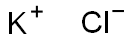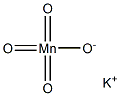
Potassiumpermanganate , ≥99.5% , 7722-64-7
Synonym(s):
Permanganic acid potassium salt;Potassium permanganate
CAS NO.:7722-64-7
Empirical Formula: KMnO4
Molecular Weight: 158.034
MDL number: MFCD00011364
EINECS: 231-760-3
PRODUCT Properties
| Melting point: | 240°C |
||||||||||||||
| Density | 1.01 g/mL at 25 °C |
||||||||||||||
| bulk density | 1300-1600kg/m3 |
||||||||||||||
| vapor pressure | <0.01 hPa (20 °C) |
||||||||||||||
| storage temp. | Store at RT. |
||||||||||||||
| solubility | H2O: 0.1 M at 20 °C, complete, violet |
||||||||||||||
| form | solution (volumetric) |
||||||||||||||
| color | Purple |
||||||||||||||
| Specific Gravity | 2.703 |
||||||||||||||
| PH | 8 (H2O, 20°C) |
||||||||||||||
| Water Solubility | 6.4 g/100 mL (20 ºC) |
||||||||||||||
| Specific Heat Capacity | Cp(crystal): 0.74 J/(g·K), at 25℃ |
||||||||||||||
| Sensitive | Light Sensitive |
||||||||||||||
| Merck | 14,7655 |
||||||||||||||
| crystal system | Nogata |
||||||||||||||
| Space group | Pnma |
||||||||||||||
| Lattice constant |
|
||||||||||||||
| Stability: | Stable, but contact with combustible material may cause fire. Substances to be avoided include reducing agents, strong acids, organic material, combustible materials, peroxides, alcohols and chemically active metals. Strong oxidant. |
||||||||||||||
| InChI | 1S/K.Mn.4O/q+1;;;;;-1 |
||||||||||||||
| InChIKey | VZJVWSHVAAUDKD-UHFFFAOYSA-N |
||||||||||||||
| SMILES | [K+].[O-][Mn](=O)(=O)=O |
||||||||||||||
| CAS DataBase Reference | 7722-64-7(CAS DataBase Reference) |
||||||||||||||
| EPA Substance Registry System | Potassium permanganate (7722-64-7) |
Description and Uses
Potassium permanganate, is composed of dark purple, odorless crystals with a blue metallic sheen. It is soluble in water, decomposes at 465°F (240°C), and is a powerful oxidizing material. Potassium permanganate is a dangerous fire and explosion risk in contact with organic materials. Potassium permanganate is incompatible with sulfuric acid, glycerin, and ethylene glycol. The four-digit UN identification number is 1490. The primary uses of potassium permanganate are as an oxidizer, bleach, or dye; during radioactive decontamination of the skin; and in the manufacture of organic chemicals.
Potassium permanganate (KMnO4) is a dark purple-bluish sheen crystal with a slightly sweet taste. It is produced by oxidizing manganate in an electrolytic cell or by passing carbon dioxide through a hot solution of manganate and then cooling until permanganate crystals form. It is a strong oxidizing agent, particularly with organic matter, which makes it a good disinfectant, deodorizer, bleach, and antiseptic.
Safety
| Symbol(GHS) |      GHS03,GHS05,GHS07,GHS08,GHS09 |
| Signal word | Danger |
| Hazard statements | H272-H302-H314-H361d-H373-H410 |
| Precautionary statements | P210-P260-P273-P280-P303+P361+P353-P305+P351+P338 |
| target organs | Brain |
| Hazard Codes | O,Xn,N,Xi,C |
| Risk Statements | 8-51/53-50/53-22-52/53-36/38-34 |
| Safety Statements | 60-61-36-26 |
| RIDADR | UN 1490 |
| WGK Germany | 3 |
| RTECS | SD6475000 |
| TSCA | TSCA listed |
| HS Code | 2841 61 00 |
| HazardClass | 5.1 |
| PackingGroup | II |
| Storage Class | 5.1B - Oxidizing hazardous materials |
| Hazard Classifications | Acute Tox. 4 Oral Aquatic Acute 1 Aquatic Chronic 1 Eye Dam. 1 Ox. Sol. 2 Repr. 2 Skin Corr. 1 STOT RE 2 Inhalation |
| Hazardous Substances Data | 7722-64-7(Hazardous Substances Data) |
| Toxicity | LD50 orally in rats: 1.09 g/kg (Smyth) |
| REACH Registrations | Active |
| Limited Quantities | 1.0 L (0.3 gallon) (liquid) or 1.0 kg (2.2 lbs) (solid) |
| Excepted Quantities | Max Inner Pack (30g or 30ml) and Max Outer Pack (500g or 500ml) |