
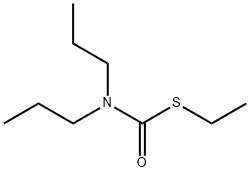
PRODUCT Properties
| Melting point: | 25°C |
| Boiling point: | 127°C (20 torr) |
| Density | 0.95 |
| vapor pressure | 3.192Pa at 25℃ |
| refractive index | nD30 1.4750 |
| Flash point: | 116 °C |
| storage temp. | 0-6°C |
| solubility | Chloroform (Slightly), Methanol (Slightly) |
| pka | -1.22±0.70(Predicted) |
| form | Liquid |
| color | Clear colorless |
| Water Solubility | 0.375 g/100 mL |
| Merck | 13,3669 |
| BRN | 1762751 |
| Henry's Law Constant | 5.6×10⁻¹ mol/(m3Pa) at 25℃, Reyes-Pérez and Calvé (2008) |
| Stability: | Stable. Incompatible with strong oxidizing agents. |
| Major Application | agriculture environmental |
| InChI | 1S/C9H19NOS/c1-4-7-10(8-5-2)9(11)12-6-3/h4-8H2,1-3H3 |
| InChIKey | GUVLYNGULCJVDO-UHFFFAOYSA-N |
| SMILES | CCCN(CCC)C(=O)SCC |
| LogP | 3.21 at 20℃ |
| NIST Chemistry Reference | Carbamothioic acid, dipropyl-, s-ethyl ester(759-94-4) |
| EPA Substance Registry System | S-Ethyl dipropylthiocarbamate (759-94-4) |
Description and Uses
EPTC is a selective herbicide. It is moderately soluble in water and is highly volatile. It is not expected to be persistent in soil systems but may be in water depending on local conditions. There may be a risk of drift. EPTC is moderately toxic to most biodiversity. This substance is also moderately toxic to mammals via the oral route. EPTC is an acetyl cholinesterase inhibitor, a neurotoxin and an irritant.
A preemergence herbicide.
Safety
| Symbol(GHS) |   GHS06,GHS09 |
| Signal word | Danger |
| Hazard statements | H302+H312-H315-H317-H319-H331-H411 |
| Precautionary statements | P273-P280-P301+P312-P302+P352+P312-P304+P340+P311-P305+P351+P338 |
| PPE | Eyeshields, Faceshields, Gloves, type ABEK (EN14387) respirator filter |
| Hazard Codes | Xn |
| Risk Statements | 22 |
| Safety Statements | 2-23 |
| RIDADR | 2902 |
| WGK Germany | 1 |
| RTECS | FA4550000 |
| TSCA | TSCA listed |
| HazardClass | 6.1(b) |
| PackingGroup | III |
| HS Code | 29302000 |
| Storage Class | 6.1C - Combustible acute toxic Cat.3 toxic compounds or compounds which causing chronic effects |
| Hazard Classifications | Acute Tox. 3 Inhalation Acute Tox. 4 Dermal Acute Tox. 4 Oral Aquatic Chronic 2 Eye Irrit. 2 Skin Irrit. 2 Skin Sens. 1 |
| Hazardous Substances Data | 759-94-4(Hazardous Substances Data) |
| Toxicity | LD50 orally in rats: 1631 mg/kg (Antognini) |
| REACH Registrations | Active |
