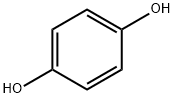
Hydroquinone solution , analyticalstandard,1000ug/mlinmethanol , 123-31-9
Synonym(s):
1,4-Benzenediol;1,4-Dihydroxybenzene;1,4-Dihydroxybenzene, Quinol;HQ;Hydroquinone
CAS NO.:123-31-9
Empirical Formula: C6H6O2
Molecular Weight: 110.11
MDL number: MFCD00002339
EINECS: 204-617-8
PRODUCT Properties
| Melting point: | 172-175 °C(lit.) |
| Boiling point: | 285 °C(lit.) |
| bulk density | 600kg/m3 |
| Density | 1.32 |
| vapor density | 3.81 (vs air) |
| vapor pressure | 1 mm Hg ( 132 °C) |
| refractive index | 1.6320 |
| Flash point: | 165 °C |
| storage temp. | Store below +30°C. |
| solubility | H2O: 50 mg/mL, clear |
| pka | 10.35(at 20℃) |
| form | Needle-Like Crystals or Crystalline Powder |
| color | White to off-white |
| Odor | odorless |
| biological source | synthetic |
| Water Solubility | 70 g/L (20 ºC) |
| Specific Heat Capacity | Cp(crystal): 1.24 J/(g·K), at 25℃ |
| Sensitive | Air & Light Sensitive |
| Merck | 14,4808 |
| BRN | 605970 |
| Henry's Law Constant | (x 10-9 atmm3/mol):
<2.07 at 20 °C (approximate - calculated from water solubility and vapor pressure) |
| Exposure limits | ACGIH:TLV-TWA 1 mg/m3 OSHA:PEL-TWA 2 mg/m3 NIOSH:REL-Ceiling 2 mg/m3[15-min] |
| Stability: | Stable. Combustible. Incompatible with strong oxidizing agents, strong bases, oxygen, ferric salts. Light and air-sensitive. Discolours in air. |
| Cosmetics Ingredients Functions | FRAGRANCE HAIR DYEING REDUCING ANTIOXIDANT BLEACHING |
| Cosmetic Ingredient Review (CIR) | Hydroquinone (123-31-9) |
| InChI | 1S/C6H6O2/c7-5-1-2-6(8)4-3-5/h1-4,7-8H |
| InChIKey | QIGBRXMKCJKVMJ-UHFFFAOYSA-N |
| SMILES | Oc1ccc(O)cc1 |
| LogP | 0.59 at 20℃ |
| CAS DataBase Reference | 123-31-9(CAS DataBase Reference) |
| IARC | 3 (Vol. 15, Sup 7, 71) 1999 |
| NIST Chemistry Reference | Hydroquinone(123-31-9) |
| EPA Substance Registry System | Hydroquinone (123-31-9) |
Description and Uses
Hydroquinone (HQ) is produced by the oxidation of aniline or phenol, by the reduction of quinone, or from a reaction of acetylene and carbon monoxide. Hydroquinone occurs naturally as a glucose ether, also known as arbutin, in the leaves of many plants and in fruits, as well as one of the agents used in the defense mechanism of the bombardier beetle, family Carabidae.
hydroquinone is a pigment-lightening agent used in bleaching creams. Hydroquinone combines with oxygen very rapidly and becomes brown when exposed to air. Although it occurs naturally, the synthetic version is the one commonly used in cosmetics. Application to the skin may cause allergic reaction and increase skin sun sensitivity. Hydroquinone is potentially carcinogenic and is associated with causing ochronosis, a discoloration of the skin. The u.S. FDA has banned hydroquinone from oTC cosmetic formulations, but allows 4 percent in prescription products. Its use in cosmetics is prohibited in some european countries and in Australia.
Safety
| Symbol(GHS) |     GHS05,GHS07,GHS08,GHS09 |
| Signal word | Danger |
| Hazard statements | H302-H315-H318-H370-H372-H373-H317-H341-H351-H410 |
| Precautionary statements | P501-P273-P272-P260-P270-P202-P201-P264-P280-P302+P352-P391-P308+P311-P362+P364-P333+P313-P301+P312+P330-P305+P351+P338+P310-P405 |
| PPE | Eyeshields, Faceshields, Gloves, type P3 (EN 143) respirator cartridges |
| Hazard Codes | Xn,N |
| Risk Statements | 22-40-41-43-50-68-R68-R50-R43-R41-R40-R22 |
| Safety Statements | 26-36/37/39-61-S61-S36/37/39-S26 |
| RIDADR | 2662 |
| OEL | Ceiling: 2 mg/m3 [15-minute] |
| WGK Germany | 3 |
| RTECS | MX3500000 |
| Autoignition Temperature | 930 °F |
| TSCA | TSCA listed |
| HazardClass | 9 |
| PackingGroup | III |
| HS Code | 29072210 |
| Storage Class | 11 - Combustible Solids |
| Hazard Classifications | Acute Tox. 4 Oral Aquatic Acute 1 Aquatic Chronic 1 Carc. 2 Eye Dam. 1 Muta. 2 Skin Sens. 1B |
| Hazardous Substances Data | 123-31-9(Hazardous Substances Data) |
| Toxicity | LD50 orally in rats: 320 mg/kg (Woodard) |
| IDLA | 50 mg/m3 |
| REACH Registrations | Active |
| Limited Quantities | 5.0 kg (11 lbs) (solid) |
| Excepted Quantities | Max Inner Pack (30g or 30ml) and Max Outer Pack (1Kg or 1L) |