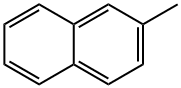
2-Methylnaphthalene , 97% , 91-57-6
Synonym(s):
β-Methylnaphthalene
CAS NO.:91-57-6
Empirical Formula: C11H10
Molecular Weight: 142.2
MDL number: MFCD00004118
EINECS: 202-078-3
PRODUCT Properties
| Melting point: | 34-36 °C(lit.) |
| Boiling point: | 241-242 °C(lit.) |
| Density | 1.01 |
| vapor pressure | 5.4 (extrapolated, Mackay et al., 1982) |
| refractive index | 1.6019 |
| Flash point: | 208 °F |
| storage temp. | 2-8°C |
| solubility | 0.025g/l |
| form | Crystalline Low Melting Solid |
| color | White |
| Odor | at 1.00 % in dipropylene glycol. sweet floral woody |
| Odor Type | floral |
| Water Solubility | 0.00246 g/100 mL |
| FreezingPoint | 34.5℃ |
| Specific Heat Capacity | Cp(crystal): 1.38 J/(g·K), at 25℃ |
| BRN | 906859 |
| Henry's Law Constant | 6.13 at 25 °C (thermodynamic method-GC/UV spectrophotometry, Altschuh et al., 1999) |
| Exposure limits | ACGIH: TWA 0.5 ppm (Skin) |
| Stability: | Stable. Incompatible with strong oxidizing agents. |
| Major Application | environmental |
| Cosmetics Ingredients Functions | PERFUMING |
| InChI | 1S/C11H10/c1-9-6-7-10-4-2-3-5-11(10)8-9/h2-8H,1H3 |
| InChIKey | QIMMUPPBPVKWKM-UHFFFAOYSA-N |
| LogP | 3.860 |
| CAS DataBase Reference | 91-57-6(CAS DataBase Reference) |
| NIST Chemistry Reference | Naphthalene, 2-methyl-(91-57-6) |
| EPA Substance Registry System | 2-Methylnaphthalene (91-57-6) |
Description and Uses
2-Methylnaphthalene is a polycyclic aromatic hydrocarbon (PAH), consisting of two-fused aromatic rings with a methyl group attached on one of the rings at the number two carbon.
2-Methylnaphthalene is a natural component of crude oil and coal, and is found in pyrolysis and combustion products such as cigarette and wood smoke, emissions from combustion engines, asphalt, coal tar residues, and used oils (ATSDR, 1995; HSDB, 2002; Warshawsky, 2001).
In the United States, 2-methylnaphthalene is used for making detergents, dyes, solvents, as well as vitamin K. 2-methylnapthalene is also used to make some pesticides, or as an additional ingredient in some pesticides. 2- methylnaphthalene is released into the environment when wood or fossil fuels are burned or when there are spills of products containing fossil fuels. 2-methylnaphthalene can evaporate or break down quickly in soils exposed to air or containing certain microorganisms, but it could stay a year or more under other conditions in certain sediments or soils.
The main uses of methylnaphthalene are as a raw material for dyestuff dispersants and heat transfer oils, and as a solvent for agricultural chemical. It has been used as an indicator of smoke exposure in food and packaging materials.
Safety
| Symbol(GHS) |     GHS02,GHS07,GHS08,GHS09 |
| Signal word | Warning |
| Hazard statements | H302-H319-H373-H335-H336-H411-H228 |
| Precautionary statements | P501-P273-P260-P270-P240-P210-P241-P271-P264-P280-P370+P378-P391-P314-P337+P313-P305+P351+P338-P301+P312+P330-P304+P340+P312-P403+P233-P405 |
| target organs | Eyes,Central nervous system |
| PPE | Eyeshields, Faceshields, Gloves, type ABEK (EN14387) respirator filter |
| Hazard Codes | F,Xn,N |
| Risk Statements | 22-36/37/38-51/53-63-43-23/24/25-45-20/21/22-67-40 |
| Safety Statements | 26-37/39-61-36/37-24/25-23-53-36-29 |
| RIDADR | UN 3077 9/PG 3 |
| WGK Germany | 2 |
| RTECS | QJ9635000 |
| TSCA | TSCA listed |
| HazardClass | 9 |
| PackingGroup | III |
| HS Code | 29029080 |
| Storage Class | 3 - Flammable liquids |
| Hazard Classifications | Acute Tox. 3 Dermal Acute Tox. 3 Inhalation Acute Tox. 3 Oral Flam. Liq. 2 STOT SE 1 |
| Hazardous Substances Data | 91-57-6(Hazardous Substances Data) |
| Toxicity | Acute oral LD50 for rats 1,630 mg/kg (quoted, RTECS, 1985). |
| REACH Registrations | Active |