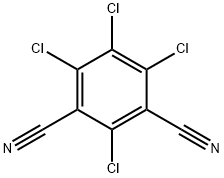
ChlorothalonilSolutioninAcetonitrile , 100μg/mLinAcetonitrile,uncertainty3% , 1897-45-6
Synonym(s):
TRN;KPNB2;MIP1;Tetrachloroisophthalodinitrile;TNPO1
CAS NO.:1897-45-6
Empirical Formula: C8Cl4N2
Molecular Weight: 265.91
MDL number: MFCD00045594
EINECS: 217-588-1
| Pack Size | Price | Stock | Quantity |
| 1.2ml | RMB79.20 | In Stock |
|
| others | Enquire |
PRODUCT Properties
| Melting point: | 250-251° |
| Boiling point: | bp760 350° |
| Density | d425 1.7 |
| vapor pressure | 7.6 x 10⁻⁵ Pa (25 °C) |
| Flash point: | 2 °C |
| storage temp. | 0-6°C |
| solubility | 180mg/L in organic solvents at 20 ℃ |
| Water Solubility | 0.6-1.2 mg l-1 (25 °C) |
| form | Powder |
| color | White |
| Odor | odorless in pure form |
| Merck | 14,2166 |
| BRN | 1978326 |
| Henry's Law Constant | 5.0×101 mol/(m3Pa) at 25℃, Kawamoto and Urano (1989) |
| Exposure limits | MAC:1 mg/m3 |
| Stability: | Light Sensitive |
| Major Application | agriculture cleaning products cosmetics environmental food and beverages personal care |
| InChI | 1S/C8Cl4N2/c9-5-3(1-13)6(10)8(12)7(11)4(5)2-14 |
| InChIKey | CRQQGFGUEAVUIL-UHFFFAOYSA-N |
| SMILES | Clc1c(Cl)c(C#N)c(Cl)c(C#N)c1Cl |
| LogP | 2.94 at 25℃ |
| CAS DataBase Reference | 1897-45-6(CAS DataBase Reference) |
| IARC | 2B (Vol. Sup 7, 73) 1999 |
| NIST Chemistry Reference | Tetrachloroisophthalonitrile(1897-45-6) |
| EPA Substance Registry System | Chlorothalonil (1897-45-6) |
Description and Uses
Chlorothalonil is a pesticide fungicide commonly used in the cultivation of ornamental plants and flowers, rice, and onions. In banana plantations it is used in fumigations by airplanes. It can be used as a preservative of paints and of woods. Chlorothalonil can induce contact urticaria, irritant and allergic contact dermatitis, erythema dychromicum perstans or folliculitis mainly in agricultural workers, in those in wood-related professions or in hortieulturists.
Chlorothalonil is a non-systemic foliar fungicide with protective activity. It is used to control a broad spectrum of fungal diseases in fruit (pome, stone, citrus, etc.), berries, vegetables, cucurbits, root crops, soyabeans, ornamentals and turf.
Safety
| Symbol(GHS) |     GHS05,GHS06,GHS08,GHS09 |
| Signal word | Danger |
| Hazard statements | H317-H318-H330-H335-H351-H410 |
| Precautionary statements | P202-P273-P280-P302+P352-P304+P340+P310-P305+P351+P338 |
| target organs | Respiratory system |
| PPE | dust mask type N95 (US), Eyeshields, Faceshields, Gloves, type P2 (EN 143) respirator cartridges |
| Hazard Codes | T+;N,N,T+,Xn,F |
| Risk Statements | 26-37-40-41-43-50/53-36-20/21/22-11 |
| Safety Statements | 28-36/37/39-45-60-61-36/37-26-16 |
| RIDADR | 3276 |
| WGK Germany | 3 |
| RTECS | NT2600000 |
| TSCA | TSCA listed |
| HazardClass | 6.1(a) |
| PackingGroup | I |
| HS Code | 29269090 |
| Storage Class | 6.1A - Combustible acute toxic Cat. 1 and 2 very toxic hazardous materials |
| Hazard Classifications | Acute Tox. 2 Inhalation Aquatic Acute 1 Aquatic Chronic 1 Carc. 2 Eye Dam. 1 Skin Sens. 1 STOT SE 3 |
| Hazardous Substances Data | 1897-45-6(Hazardous Substances Data) |
| Toxicity | LD50 orally in rats: >10.0 g/kg (Turner) |
| REACH Registrations | Active |