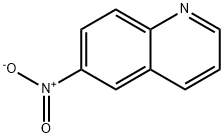
PRODUCT Properties
| Melting point: | 151-153 °C(lit.) |
| Boiling point: | 305.12°C (rough estimate) |
| Density | 1.2190 (estimate) |
| refractive index | 1.6820 (rough estimate) |
| storage temp. | Sealed in dry,Room Temperature |
| Water Solubility | Slightly soluble in water |
| pka | 3.24±0.10(Predicted) |
| form | powder to crystal |
| color | Needles from water or alc |
| BRN | 136138 |
| InChI | InChI=1S/C9H6N2O2/c12-11(13)8-3-4-9-7(6-8)2-1-5-10-9/h1-6H |
| InChIKey | SMHPLBXIVNQFBA-UHFFFAOYSA-N |
| SMILES | N1C2C(=CC([N+]([O-])=O)=CC=2)C=CC=1 |
| CAS DataBase Reference | 613-50-3(CAS DataBase Reference) |
| EPA Substance Registry System | 6-Nitroquinoline (613-50-3) |
Description and Uses
6-Nitroquinoline serves as a precursor for synthesizing 6-hydroxylaminoquinoline via reduction with hydrazine hydrate in the presence of Raney nickel. It acts as a pro-fluorescent substrate that is converted to the fluorophore 6-aminoquinoline by xanthine/xanthine oxidase under hypoxic conditions, or to 6-nitroquinolin-2(1H)-one by xanthine oxidase under aerobic conditions. The compound is also employed for the quantitative determination and removal of palladium from solution using hot saturated aqueous conditions, and its electrochemical behavior allows for detection via polarographic and voltammetric methods[3][4][5].
Safety
| Symbol(GHS) |   GHS07,GHS08 |
| Signal word | Warning |
| Hazard statements | H302+H312+H332-H351 |
| Precautionary statements | P201-P280-P301+P312-P302+P352+P312-P304+P340+P312-P308+P313 |
| PPE | Eyeshields, Gloves, type P3 (EN 143) respirator cartridges |
| Hazard Codes | Xn |
| Risk Statements | 20/21/22-40 |
| Safety Statements | 7-22-36-45 |
| WGK Germany | 3 |
| RTECS | VC1900000 |
| HS Code | 29339900 |
| Storage Class | 11 - Combustible Solids |
| Hazard Classifications | Acute Tox. 4 Dermal Acute Tox. 4 Inhalation Acute Tox. 4 Oral Carc. 2 |
| Toxicity | mma-sat 100 mmol/plate MUREAV 58,11,78 |