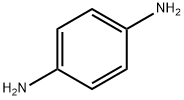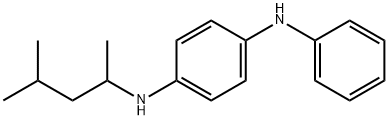
N-(1,3-Dimethylbutyl)-N'-phenyl-1,4-phenylenediamine , ≥98.0%(GC) , 793-24-8
CAS NO.:793-24-8
Empirical Formula: C18H24N2
Molecular Weight: 268.4
MDL number: MFCD00072248
EINECS: 212-344-0
| Pack Size | Price | Stock | Quantity |
| 25G | RMB95.20 | In Stock |
|
| 100G | RMB225.60 | In Stock |
|
| 500G | RMB696.80 | In Stock |
|
| 2.5KG | RMB2268.80 | In Stock |
|
| others | Enquire |
PRODUCT Properties
| Melting point: | 45-46°C |
| Boiling point: | 260°C |
| Density | 0.986~1.00g/cm3 |
| refractive index | 1.6300 (estimate) |
| Flash point: | 204°C |
| storage temp. | Keep in dark place,Sealed in dry,Room Temperature |
| solubility | soluble in Methanol |
| pka | 6.73±0.32(Predicted) |
| form | powder to lump |
| color | Light orange to Dark red to Black |
| Water Solubility | <0.1 g/100 mL at 17 ºC |
| Henry's Law Constant | 2.9×10³ mol/(m3Pa) at 25℃, Zhang et al. (2010) |
| InChI | InChI=1S/C18H24N2/c1-14(2)13-15(3)19-17-9-11-18(12-10-17)20-16-7-5-4-6-8-16/h4-12,14-15,19-20H,13H2,1-3H3 |
| InChIKey | ZZMVLMVFYMGSMY-UHFFFAOYSA-N |
| SMILES | C1(NC(C)CC(C)C)=CC=C(NC2=CC=CC=C2)C=C1 |
| CAS DataBase Reference | 793-24-8(CAS DataBase Reference) |
| EPA Substance Registry System | N-(1,3-Dimethylbutyl)-N'-phenyl-p-phenylenediamine (793-24-8) |
Description and Uses
6-PPD is a substituted p-phenylenediamine.1 It scavenges ozone, forming nitroxyl radicals.2 6-PPD decreases hatchability of zebrafish embryos by 25.6 and 78.9% when used at concentrations of 0.022 and 0.22 mg/L, respectively.1 It also reduces motility and body length, as well as induces developmental malformations and oxidative stress in, zebrafish embryos. Formulations containing 6-PPD have been used as stabilizing additives and antiozonants in rubber.WARNING This product is not for human or veterinary use.
N-(1,3-Dimethylbutyl)-N'-phenyl-p-phenylenediamine is an anti-ozone and antioxidant for natural and synthetic rubber, offering excellent protection against ozone cracking and flexural fatigue, and inhibiting the harmful effects of metals such as copper and manganese. Its performance is similar to antioxidant 4010NA, but it is less toxic and less irritating to the skin, with lower water solubility loss (washing loss rate of 4010NA is 50%, while 4020 is only 15-20%). It can be widely used in tires, belts, and other industrial rubber products, typically at a dosage of 0.5-1.5%. Because it is a polluting antioxidant, it is not suitable for manufacturing light-colored products.
Safety
| Symbol(GHS) |   GHS07,GHS09 |
| Signal word | Warning |
| Hazard statements | H302-H317-H410 |
| Precautionary statements | P261-P264-P273-P280-P301+P312-P302+P352 |
| Hazard Codes | Xn,N |
| Risk Statements | 22-43-50/53 |
| Safety Statements | 36/37-60-61 |
| RIDADR | UN 3077 9 / PGIII |
| WGK Germany | 2 |
| RTECS | ST0900000 |
| TSCA | TSCA listed |
| HazardClass | 9 |
| PackingGroup | III |
| HS Code | 29215190 |
| Storage Class | 11 - Combustible Solids |
| Hazard Classifications | Acute Tox. 4 Oral Aquatic Acute 1 Aquatic Chronic 1 Skin Sens. 1 |
| Hazardous Substances Data | 793-24-8(Hazardous Substances Data) |
| Toxicity | LD50 oral in rat: 3580mg/kg |
| REACH Registrations | Active |