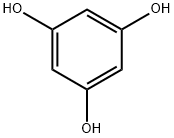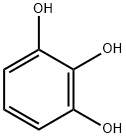
Pyrogallic , AR , 87-66-1
Synonym(s):
1,2,3-Trihydroxybenzene;2,3-Dihydroxyphenol;Pyrogallic acid;Pyrogallic acid, 1,2,3-Trihydroxybenzene;Pyrogallol
CAS NO.:87-66-1
Empirical Formula: C6H6O3
Molecular Weight: 126.11
MDL number: MFCD00002192
EINECS: 201-762-9
| Pack Size | Price | Stock | Quantity |
| 100G | RMB50.40 | In Stock |
|
| 500G | RMB210.40 | In Stock |
|
| others | Enquire |
PRODUCT Properties
| Melting point: | 43-47 °C(lit.) |
| Boiling point: | 309 °C |
| bulk density | 600kg/m3 |
| Density | 1.112 g/mL at 25 °C(lit.) |
| vapor density | 4.4 (vs air) |
| vapor pressure | 10 mm Hg ( 167.7 °C) |
| refractive index | n |
| Flash point: | >230 °F |
| storage temp. | Store below +30°C. |
| solubility | water: soluble |
| pka | pK1:9.03(0);pK2:11.63(+1) (25°C) |
| form | Very Fine Crystalline Powder |
| color | White |
| PH | 4-5 (50g/l, H2O, 20℃) |
| Water Solubility | 400 g/L (25 ºC) |
| Sensitive | Light Sensitive |
| Merck | 14,8000 |
| BRN | 907431 |
| Henry's Law Constant | 6.3×10⁴ mol/(m3Pa) at 25℃, HSDB (2015) |
| Stability: | Stable, but decolourises in light. Combustible. Incompatible with strong oxidising agents, alkalies, metal oxides, ammonia, antipyrine, phenol, iodine, lime water, menthol, potassium permanganate, strong bases. |
| Major Application | pharmaceutical (small molecule) |
| Cosmetics Ingredients Functions | HAIR DYEING |
| InChI | 1S/C6H6O3/c7-4-2-1-3-5(8)6(4)9/h1-3,7-9H |
| InChIKey | WQGWDDDVZFFDIG-UHFFFAOYSA-N |
| SMILES | Oc1cccc(O)c1O |
| LogP | -0.47 |
| CAS DataBase Reference | 87-66-1(CAS DataBase Reference) |
| NIST Chemistry Reference | 1,2,3-Benzenetriol(87-66-1) |
| EPA Substance Registry System | Pyrogallol (87-66-1) |
Description and Uses
Pyrogallol is a natural oxidant that can generate superoxide (O2-) in alkaline solutions through autoxidation to a semiquinone radical. Importantly, the semiquinone radical can react with O2- in an acidic environment to produce a quinone and H2O2. Pyrogallol autoxidation is used in superoxide dismutase activity assays. It can also be used in assays to assess antioxidant capacity. Pyrogallol is used in some biological systems as an O2- scavenger. In other biological systems, it is used as an O2- generator. Pyrogallol effectively scavenges DPPH radical and ABTS+ in vitro. Pyrogallol is a product of tannin degradation to gallic acid by ruminant microbes and has hepatotoxic and nephrotoxic effects in vivo.
Pyrogallol possesses importance as a spectrophotometric reagent in the determination of niobium and tantalum. The absorptions of niobium and tantalum complexes are usually measured at 340 and 335 nm, respectively. The niobium complex is formed in slightly acidic medium, and the tantalum complex in strongly acidic medium (4 N HC1). The absorption spectra are pH-dependen.
Safety
| Symbol(GHS) |   GHS07,GHS08 |
| Signal word | Warning |
| Hazard statements | H302+H312+H332-H341-H412 |
| Precautionary statements | P273-P280-P301+P312-P302+P352+P312-P304+P340+P312-P308+P313 |
| PPE | dust mask type N95 (US), Eyeshields, Faceshields, Gloves, type P3 (EN 143) respirator cartridges |
| Hazard Codes | Xn |
| Risk Statements | 20/21/22-52/53-68-40-36/38 |
| Safety Statements | 22-24/25-61-36/37-26 |
| RIDADR | UN 2811 6.1/PG 3 |
| WGK Germany | 3 |
| RTECS | UX2800000 |
| F | 8 |
| TSCA | TSCA listed |
| HS Code | 2907 29 00 |
| HazardClass | 6.1 |
| PackingGroup | III |
| Storage Class | 11 - Combustible Solids |
| Hazard Classifications | Acute Tox. 4 Dermal Acute Tox. 4 Inhalation Acute Tox. 4 Oral Aquatic Chronic 3 Muta. 2 |
| Hazardous Substances Data | 87-66-1(Hazardous Substances Data) |
| Toxicity | LD50 orally in rabbits: 1.6 g/kg (Dollahite) |
| REACH Registrations | Active |
| Limited Quantities | 5.0 kg (11 lbs) (solid) |
| Excepted Quantities | Max Inner Pack (30g or 30ml) and Max Outer Pack (1Kg or 1L) |