
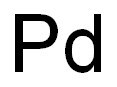
Alladium , 99.95%metalsbasis , 7440-05-3
CAS NO.:7440-05-3
Empirical Formula: Pd
Molecular Weight: 106.42
MDL number: MFCD00011167
EINECS: 231-115-6
| Pack Size | Price | Stock | Quantity |
| 250mg | RMB479.20 | In Stock |
|
| 200mg | RMB719.20 | In Stock |
|
| 1G | RMB2519.20 | In Stock |
|
| 5G | RMB8799.20 | In Stock |
|
| others | Enquire |
PRODUCT Properties
| Melting point: | 1554 °C(lit.) |
| Boiling point: | 2970 °C(lit.) |
| Density | 1.025 g/mL at 25 °C |
| storage temp. | no restrictions. |
| solubility | soluble in aqua regia |
| form | wire |
| color | Silver-gray |
| Specific Gravity | 12.03 |
| Odor | Odorless |
| Resistivity | 9.96 μΩ-cm, 20°C |
| Water Solubility | INSOLUBLE |
| Electrical Conductivity | 1× 10⁷S/m |
| Thermal Conductivity | 71 W/(m·K) |
| Specific Heat Capacity | Cp(crystal): 0.24 J/(g·K); Cp(gas): 0.2 J/(g·K), at 25℃ |
| Merck | 14,6989 |
| Exposure limits | ACGIH: TWA 1 mg/m3 OSHA: TWA 15 mg/m3; TWA 5 mg/m3 |
| Stability: | Stable. Flammable - fine powder may cause fire or explosion in air. Incompatible with ozone, sodium tetrahydroborate, sulphur, arsenic. |
| Cosmetics Ingredients Functions | COLORANT |
| InChI | 1S/Pd |
| InChIKey | KDLHZDBZIXYQEI-UHFFFAOYSA-N |
| SMILES | [Pd] |
| Shear Modulus | 42.0 GPa, Calculated |
| Poissons Ratio | 0.39 |
| Modulus of Elasticity | 117 GPa |
| Hardness, Vickers | 37, Annealed 105, Cold Drawn |
| CAS DataBase Reference | 7440-05-3(CAS DataBase Reference) |
| NIST Chemistry Reference | Palladium(7440-05-3) |
| EPA Substance Registry System | Palladium (7440-05-3) |
Description and Uses
Palladium was discovered in 1803 by W.H. Wollaston during refining and purification of- platinum metal. This new metal was found in the aqua regia extract of native platinum and was detected in solution after platinum was precipitated. It was removed as ammonium chloroplatinate. Treating this solution with mercurous cyanide precipitated a yellow palladium complex salt. The precipitate was washed and ignited to form palladium metal. Wollaston named the element palladium after the newly discovered asteroid Pallas.
Palladium in nature is always associated with other platinum group metals. Its abundance in earth's crust is estimated at 0.015 mg/kg, about three times more abundant than platinum. Palladium is used mostly in alloys and the majority of its alloys are used for electronics and telecommunications. They are contacts in electrical relays and automatic switching gear. Palladium-gold alloys are applied widely in dentistry and medicine. They are in devices for replacement of damaged bones and joints and as support in porcelain-overlay bridgework. Palladium alloys are used in decoration and jewelry as a substitute for gold. They are used in gems, watch cases and brooches.
One of the most important applications of palladium is to catalyze hydrogenation, dehydrogenation, and petroleum cracking. Such reactions are widely employed in organic syntheses and petroleum refining. Palladium and platinum are installed in catalytic converters in automobiles to cut down the emission of unsaturated hydrocarbon gasses.
Palladium is a soft white metal found in copper and nickel ores. The chloride compound of this element was used after the turn of the century for printing and also in combination with platinum for printing.
Palladium is a transition metal element used in catalytic reactions involving processes such as hydrogenation. Lindlar Catalyst.
In form of gold, silver, and copper alloys in dentistry; for alloy bearings, springs, balance wheels of watches; for mirrors in astronomical instruments; as catalyzer in manufacture of sulfuric acid and in other oxidizing processes; in powder form as catalyst in hydrogenation and in ignition of hydrogen or hydrocarbons with oxygen; the spongy form is used in gas analysis for separating hydrogen from mixtures of gases.
Safety
| Symbol(GHS) |  GHS07 |
| Signal word | Warning |
| Hazard statements | H315-H319 |
| Precautionary statements | P305+P351+P338 |
| Hazard Codes | T,F,Xi |
| Risk Statements | 61-33-37/38-40-41-36/37/38-11 |
| Safety Statements | 53-26-36/37/39-24/25-36-22 |
| RIDADR | UN 3089 4.1/PG 2 |
| WGK Germany | nwg |
| RTECS | RT3480500 |
| Autoignition Temperature | >1120 °F |
| TSCA | TSCA listed |
| HazardClass | 4.1 |
| PackingGroup | III |
| HS Code | 28439000 |
| Storage Class | 13 - Non Combustible Solids |
| Hazardous Substances Data | 7440-05-3(Hazardous Substances Data) |
| Toxicity | LD50 oral (rat) 200 mg/kg (palladium chloride) LC50 intratracheal (rat) 6 mg/kg (palladium chloride) |
| REACH Registrations | Active |
| Limited Quantities | 1.0 Kg (2.2 lbs) |
| Excepted Quantities | Max Inner Pack (30g or 30ml) and Max Outer Pack (500g or 500ml) |
