PRODUCT Properties
| Melting point: | 253 °C (dec.) (lit.) |
| Boiling point: | 367.84°C (rough estimate) |
| alpha | 20.9 º (c=1.5, H2O) |
| Density | 1.2673 (rough estimate) |
| vapor pressure | 0Pa at 25℃ |
| refractive index | 21 ° (C=2, H2O) |
| storage temp. | -20°C |
| solubility | DMSO (Very Slightly), Water (Slightly) |
| form | crystalline |
| pka | 2.62(at 25℃) |
| color | White |
| Odor | at 100.00%. odorless |
| optical activity | +24.120 |
| Water Solubility | almost transparency |
| Merck | 14,1850 |
| BRN | 87671 |
| Stability: | Stable, but may be heat sensitive - store cold. Incompatible with strong oxidizing agents. |
| Major Application | food and beverages personal care pharmaceutical |
| Cosmetics Ingredients Functions | SKIN CONDITIONING |
| InChI | 1S/C9H14N4O3/c10-2-1-8(14)13-7(9(15)16)3-6-4-11-5-12-6/h4-5,7H,1-3,10H2,(H,11,12)(H,13,14)(H,15,16)/t7-/m0/s1 |
| InChIKey | CQOVPNPJLQNMDC-ZETCQYMHSA-N |
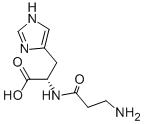
| SMILES | NCCC(=O)N[C@@H](Cc1c[nH]cn1)C(O)=O |
| LogP | -3.8 at 22℃ |
| CAS DataBase Reference | 305-84-0(CAS DataBase Reference) |
| EPA Substance Registry System | L-Histidine, .beta.-alanyl- (305-84-0) |
Description and Uses
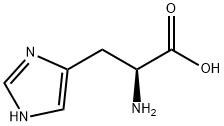
L-Carnosine is a dipeptide composed of β-alanine and L-histidine that has been found in rat olfactory bulb, skeletal muscle, brain, kidney, and spleen tissues, as well as human skeletal muscle, and has diverse biological activities. It is a metal chelator that forms complexes with copper, cobalt, nickel, cadmium, or zinc. Dietary administration of L-carnosine (60 mg/kg per day) reduces plasma levels of advanced glycation end products (AGEs) in diabetic rats. It reduces brain edema, blood-brain barrier disruption, microglial activation, and neuronal apoptosis in a rat model of intracerebral hemorrhage when administered at a dose of 1,000 mg/kg. L-Carnosine (250, 500, and 1,000 mg/kg, i.p.) reduces hepatic protein carbonylation and necrosis in a rat model of cirrhosis induced by bile duct ligation. It also reduces lung myeloperoxidase (MPO) activity, production of reactive oxygen species (ROS), and TNF-α and IL-6 levels, as well as alveolar hemorrhage, interstitial edema, and pulmonary leukocyte infiltration in a mouse model of LPS-induced lung injury.
L-Carnosine is a naturally-occurring histidine-containing compound and the biological role of this dipeptide is to act as cytosolic buffering agents. Other roles ascribed to L-Carnosine include action s as neurotransmitters, modulation of enzymic activities and chelation of heavy metals. Studies indicate an ability to boost the immunological functions. In cosmetics, it has anti-aging and skin-conditioning applications.
Safety
| Symbol(GHS) |  GHS07 |
| Signal word | Warning |
| Hazard statements | H315-H319 |
| Precautionary statements | P264-P280-P302+P352-P321-P332+P313-P362-P264-P280-P305+P351+P338-P337+P313P |
| Hazard Codes | Xn |
| Risk Statements | 20/21/22-36/37/38 |
| Safety Statements | 24/25-36-26 |
| WGK Germany | 2 |
| RTECS | MS3080000 |
| F | 3-10 |
| TSCA | TSCA listed |
| HS Code | 29332900 |
| Storage Class | 11 - Combustible Solids |
| Toxicity | LD50 oral in mouse: > 14930mg/kg |
| REACH Registrations | Active |