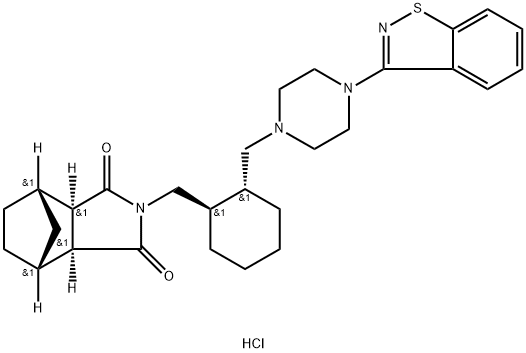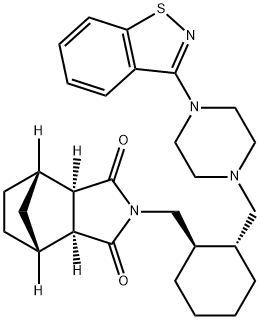
Lurasidone , 10mMinDMSO , 367514-87-2
CAS NO.:367514-87-2
Empirical Formula: C28H36N4O2S
Molecular Weight: 492.68
MDL number: MFCD14635357
EINECS: 696-042-8
| Pack Size | Price | Stock | Quantity |
| 1ml | RMB159.20 | In Stock |
|
| others | Enquire |
PRODUCT Properties
| Melting point: | 146-149°C |
| Boiling point: | 623.4±55.0 °C(Predicted) |
| Density | 1.273 |
| storage temp. | -20°C Freezer |
| solubility | Chloroform (Slightly), DMSO (Slightly, Heated), Methanol (Slightly, Heated) |
| pka | 8.41±0.50(Predicted) |
| form | Solid |
| color | White to Off-White |
| InChIKey | PQXKDMSYBGKCJA-CVTJIBDQSA-N |
| SMILES | C1(=O)[C@]2([H])[C@@]([H])([C@]3([H])C[C@@]2([H])CC3)C(=O)N1C[C@@H]1CCCC[C@H]1CN1CCN(C2C3=C(SN=2)C=CC=C3)CC1 |
| CAS DataBase Reference | 367514-87-2 |
Description and Uses
The atypical antipsychotic lurasidone (also known as SM-13496) was approved in the United States in 2010 as an oral agent for the treatment of patients with schizophrenia. Lurasidone has potent affinity for D2 (Ki= 1.7 nM) and 5-HT2A (Ki= 2.0 nM) receptors and acts as an antagonist at both receptors. It is also a partial agonist at the 5-HT1A receptor and, unlike other atypical agents, is a potent antagonist at the 5-HT7 receptor; both of these activities are thought to confer beneficial cognitive properties. Lurasidone is further differentiated by its lack of affinity for muscarinic and histamine H1 receptors and its weak affinity for the 5-HT2C receptor. Antagonism at H1 and 5-HT2C receptors has been implicated in weight gain associated with atypical agents, while muscarinic receptor antagonism is associated with cognitive deficits.
Lurasidone is a benzisothiazole derivative (C28H36N4O2S·HCl, MW 529.14) and second-generation atypical antipsychotic that functions as a complete antagonist at dopamine D2 and serotonin 5-HT2A receptors[1][2][3]. Approved by the FDA in 2010 for schizophrenia in adults and later for major depressive episodes associated with bipolar I disorder, lurasidone reduces positive and negative symptoms, anxiety, depression, and suicidal ideation[1][2][4]. Clinical studies support its efficacy and safety in short- and long-term treatment, with a favorable metabolic profile characterized by lower propensity for weight gain and minimal impact on glucose, lipids, and QTc interval[2][4]. The recommended starting dose for schizophrenia is 37 mg/day, administered once daily with a meal to ensure adequate absorption[2][4].
Safety
| Symbol(GHS) |  GHS07 |
| Signal word | Warning |
| Hazard statements | H302 |
| Precautionary statements | P280-P305+P351+P338 |
| Hazardous Substances Data | 367514-87-2(Hazardous Substances Data) |
| REACH Registrations | Active |