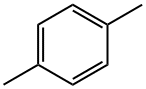
A8433912
p-Xylene , StandardforGC,≥99.8%(GC) , 106-42-3
Synonym(s):
p-Xylene;1;1,4-Dimethylbenzene;Dimethylbenzol;p-Xylene
CAS NO.:106-42-3
Empirical Formula: C8H10
Molecular Weight: 106.17
MDL number: MFCD00008556
EINECS: 203-396-5
Update time: 2022-07-08
PRODUCT Properties
| Melting point: | 12-13 °C (lit.) |
| Boiling point: | 138 °C (lit.) |
| Density | 0.861 g/mL at 20 °C (lit.) |
| vapor density | 3.7 (vs air) |
| vapor pressure | 9 mm Hg ( 20 °C) |
| refractive index | n |
| Flash point: | 77 °F |
| storage temp. | Store at +5°C to +30°C. |
| solubility | water: soluble0.2g/L |
| pka | >15 (Christensen et al., 1975) |
| form | Liquid |
| color | Colorless |
| Relative polarity | 0.074 |
| Odor | Like benzene; characteristic aromatic. |
| Odor Threshold | 0.058ppm |
| explosive limit | 1.1-7%(V) |
| Water Solubility | Miscible with alcohol, ether, acetone, benzene and chloroform. Immiscible with water. |
| Thermal Conductivity | 0.1202 W/(m·K) at 25 ℃ |
| Specific Heat Capacity | Cp(liquid): 1.71 J/(g·K), at 25℃ |
| λmax | λ: 294 nm Amax: 1.00 λ: 320 nm Amax: 0.10 λ: 350 nm Amax: 0.05 λ: 380-400 nm Amax: 0.01 |
| Merck | 14,10081 |
| BRN | 1901563 |
| Henry's Law Constant | 16.1 at 45.00 °C, 18.6 at 50.00 °C, 20.3 at 55.00 °C, 23.4 at 60.00 °C, 30.5 at 70.00 °C (static
headspace-GC, Park et al., 2004) |
| Dielectric constant | 2.6(20℃) |
| Exposure limits | ACGIH TLV-TWA:20 ppm;TLV-STEL:150 ppm (~651 mg/m3) OSHA PEL-TWA:100 ppm (~434 mg/m3) NIOSH REL-Ceiling:200 ppm/ 10 min;IDLH:1000 ppm |
| Stability: | Stable. Incompatible with oxidizing agents. Hygroscopic. Flammable. |
| Major Application | environmental |
| InChI | 1S/C8H10/c1-7-3-5-8(2)6-4-7/h3-6H,1-2H3 |
| InChIKey | URLKBWYHVLBVBO-UHFFFAOYSA-N |
| SMILES | Cc1ccc(C)cc1 |
| LogP | 3.16 at 20℃ |
| Surface tension | 28.11mN/m at 298.15K |
| CAS DataBase Reference | 106-42-3(CAS DataBase Reference) |
| EPA Substance Registry System | p-Xylene (106-42-3) |
| ECETOC JACC REPORT | P-XYLENE (106-42-3) |
Description and Uses
Xylene occurs in petroleum solvents andgasoline. The widest applications of xyleneare as solvents in paints, coatings, and rubber.Xylene isomers are used in the manufacture ofdyes, drugs, pesticides, and in many organicintermediates, such as terephthalic acid andphthalic anhydride.
Safety
| Symbol(GHS) |     GHS02,GHS07,GHS08,GHS09 |
| Signal word | Danger |
| Hazard statements | H332-H303-H315-H319-H360-H371-H336-H304-H411-H226 |
| Precautionary statements | P501-P273-P260-P270-P202-P240-P210-P233-P201-P243-P241-P242-P271-P264-P280-P370+P378-P391-P331-P337+P313-P305+P351+P338-P308+P311-P362+P364-P303+P361+P353-P332+P313-P301+P310-P304+P340+P312-P403+P233-P403+P235-P405 |
| target organs | Respiratory system |
| PPE | Eyeshields, Faceshields, Gloves, type ABEK (EN14387) respirator filter |
| Hazard Codes | Xn,T,F |
| Risk Statements | 10-20/21-38-39/23/24/25-23/24/25-11 |
| Safety Statements | 25-45-36/37-16-7 |
| RIDADR | UN 1307 3/PG 3 |
| OEB | A |
| OEL | TWA: 100 ppm (435 mg/m3), STEL: 150 ppm (655 mg/m3) |
| WGK Germany | 2 |
| RTECS | ZE2625000 |
| Autoignition Temperature | 984 °F |
| TSCA | TSCA listed |
| HazardClass | 3 |
| PackingGroup | III |
| HS Code | 29024300 |
| Storage Class | 3 - Flammable liquids |
| Hazard Classifications | Acute Tox. 4 Dermal Acute Tox. 4 Inhalation Aquatic Chronic 3 Asp. Tox. 1 Eye Irrit. 2 Flam. Liq. 3 Skin Irrit. 2 STOT SE 3 |
| Hazardous Substances Data | 106-42-3(Hazardous Substances Data) |
| Toxicity | LD50 orally in Rabbit: 3910 mg/kg |
| REACH Registrations | Active |
| Limited Quantities | 5.0 L (1.3 gallons) (liquid) |
| Excepted Quantities | Max Inner Pack (30g or 30ml) and Max Outer Pack (1Kg or 1L) |