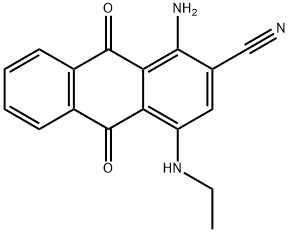
1-Amino-4-(ethylamino)-9,10-dioxo-9,10-dihydroanthracene-2-carbonitrile , 95+% , 62570-50-7
CAS NO.:62570-50-7
Empirical Formula: C17H13N3O2
Molecular Weight: 291.3
MDL number:
EINECS: 263-606-6
| Pack Size | Price | Stock | Quantity |
| 5g | RMB1707.20 | In Stock |
|
| others | Enquire |
PRODUCT Properties
| Boiling point: | 597.7±50.0 °C(Predicted) |
| Density | 1.38±0.1 g/cm3(Predicted) |
| vapor pressure | 0Pa at 25℃ |
| storage temp. | 2-8°C |
| solubility | DMSO (Slightly) |
| pka | 1.82±0.20(Predicted) |
| form | Solid |
| color | Dark Blue to Very Dark Blue |
| Water Solubility | 6.7μg/L at 20℃ |
| InChI | InChI=1S/C17H13N3O2/c1-2-20-12-7-9(8-18)15(19)14-13(12)16(21)10-5-3-4-6-11(10)17(14)22/h3-7,20H,2,19H2,1H3 |
| InChIKey | ATXPWKWYLDEURI-UHFFFAOYSA-N |
| SMILES | C1(N)=C2C(C(=O)C3=C(C2=O)C=CC=C3)=C(NCC)C=C1C#N |
| LogP | 2.4 at 20℃ |
| CAS DataBase Reference | 62570-50-7 |
| EPA Substance Registry System | 2-Anthracenecarbonitrile, 1-amino-4-(ethylamino)-9,10-dihydro-9,10-dioxo- (62570-50-7) |
Description and Uses
Disperse Blue 359 is a synthetic dye belonging to the disperse dye class. Disperse dyes are primarily used for coloring synthetic fibers, particularly polyester and acetate. The numbering system, such as "Disperse Blue 359," is a part of the Color Index (C.I.) system, an international classification system for dyes and pigments. The specific properties and uses of Disperse Blue 359 would depend on its chemical structure and formulation, which can vary among different dye manufacturers. Typically, disperse dyes are known for dissolving in organic solvents and having a good affinity for hydrophobic (water-repellent) fibers. They are commonly used in dyeing polyester fabrics used in textiles, such as clothing, upholstery, and other synthetic materials.
Disperse blue 359 dry powder 359 blue belongs to anthraquinone dye, the name is: 1-amino-4-(ethylamino)anthraquinone-2-carbonitrile. It is widely used. It is mainly used for inkjet printing and transfer printing. It can change the traditional printing and dyeing process, and improve the environmental problems of the original printing and dyeing while satisfying the printing quality.
Safety
| Symbol(GHS) |  GHS08 |
| Signal word | Warning |
| Hazard statements | H341 |
| Precautionary statements | P201-P202-P281-P308+P313-P405-P501 |
| TSCA | TSCA listed |
| REACH Registrations | Active |