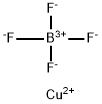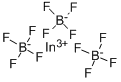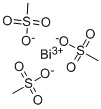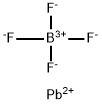
Lead(II) tetrafluoroborate , 50 , 13814-96-5
Synonym(s):
Lead boron fluoride;Lead(II) fluoroborate
CAS NO.:13814-96-5
Empirical Formula: BF4Pb+
Molecular Weight: 294
MDL number: MFCD00016270
EINECS: 237-486-0
PRODUCT Properties
| Density | 1.62 g/mL at 20 °C |
| solubility | soluble in Water |
| form | Liquid |
| color | Clear colorless |
| Water Solubility | Soluble |
| Exposure limits | ACGIH: TWA 0.05 mg/m3; TWA 2.5 mg/m3 NIOSH: IDLH 100 mg/m3; IDLH 250 mg/m3; TWA 2.5 mg/m3; TWA 0.050 mg/m3 |
| InChI | 1S/2BF4.Pb/c2*2-1(3,4)5;/q2*-1;+2 |
| InChIKey | UQGXAENNKXXYNF-UHFFFAOYSA-N |
| SMILES | [PbH2++].F[B-](F)(F)F.F[B-](F)(F)F |
| CAS DataBase Reference | 13814-96-5(CAS DataBase Reference) |
| EPA Substance Registry System | Lead fluoroborate (13814-96-5) |
Description and Uses
Lead fluoborate is a nonflammable colorlessliquid or crystalline powder with a faint odor. Specific gravity (H2O:1) = 1.75 at 20℃; Molecular weight = 380.81.Hazard Identification (based on NFPA-704 M RatingSystem): Health 1, Flammability 0, Reactivity 0. Slightlysoluble in water (decomposes).
Catalyst for mediation of calixarene formation via hydrogen-bonded dimers
Analyzed in terms of electochemical characterization of the effects of impurities and organic additives in lead electrowinning from fluoroborate electrolyte
Used in the development and optimization of a bipolar lead-boron tetrafluoride accumulator
Safety
| Symbol(GHS) |    GHS07,GHS08,GHS09 |
| Signal word | Danger |
| Hazard statements | H302-H332-H360-H373-H410 |
| Precautionary statements | P264-P270-P261-P271-P201-P202-P280-P260-P273-P301+P312-P330-P304+P340-P312-P308+P313-P314-P391-P405-P501 |
| target organs | Central nervous system,Reproductive organs |
| Hazard Codes | T,N |
| Risk Statements | 61-20/22-33-50/53-62 |
| Safety Statements | 53-45-60-61-36/37 |
| RIDADR | UN 2922 8/PG 2 |
| WGK Germany | 3 |
| RTECS | ED2700000 |
| TSCA | TSCA listed |
| HazardClass | 6.1 |
| PackingGroup | III |
| HS Code | 28269090 |
| Storage Class | 6.1C - Combustible acute toxic Cat.3 toxic compounds or compounds which causing chronic effects |
| Hazard Classifications | Acute Tox. 4 Inhalation Acute Tox. 4 Oral Aquatic Acute 1 Aquatic Chronic 1 Repr. 1A STOT RE 2 |
| Hazardous Substances Data | 13814-96-5(Hazardous Substances Data) |
| Toxicity | rat,LDLo,oral,50mg/kg (50mg/kg),Kodak Company Reports. Vol. 21MAY1971, |
| REACH Registrations | Active |