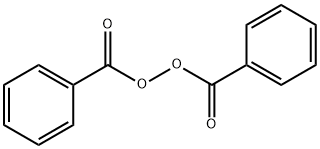
Dibenzoyl peroxide , 97 , 94-36-0
Synonym(s):
Benzoyl peroxide;Benzoyl peroxide, blend in dibutyl phthalate;Benzoyl peroxide, blend in tricresyl phosphate;Dibenzoyl peroxide
CAS NO.:94-36-0
Empirical Formula: C14H10O4
Molecular Weight: 242.23
MDL number: MFCD00003071
EINECS: 202-327-6
PRODUCT Properties
| Melting point: | 105 °C(lit.) |
| Boiling point: | 176°F |
| bulk density | 500-600kg/m3 |
| Density | 1.16 g/mL at 25 °C(lit.) |
| vapor pressure | 0.009Pa at 25℃ |
| refractive index | 1.5430 (estimate) |
| Flash point: | >230 °F |
| storage temp. | 2-8°C |
| solubility | 0.35mg/l |
| form | powder |
| color | White |
| Odor | odorless |
| Water Solubility | Insoluble |
| Merck | 14,1116 |
| BRN | 984320 |
| Henry's Law Constant | 2.8×100 mol/(m3Pa) at 25℃, HSDB (2015) |
| Exposure limits | ACGIH:TLV-TWA 5 mg/m3 OSHA:PEL-TWA 5 mg/m3 NIOSH:REL-TWA 5 mg/m3 |
| Stability: | Strong oxidizer. Highly flammable. Do not grind or subject to shock or friction. Incompatible with reducing agents, acids, bases, alcohols, metals, organic materials. Contact with combustible material, heating or friction may cause fire or explosion. |
| Cosmetics Ingredients Functions | OXIDISING |
| InChI | 1S/C14H10O4/c15-13(11-7-3-1-4-8-11)17-18-14(16)12-9-5-2-6-10-12/h1-10H |
| InChIKey | OMPJBNCRMGITSC-UHFFFAOYSA-N |
| SMILES | O(OC(=O)c2ccccc2)C(=O)c1ccccc1 |
| LogP | 3.2 at 20℃ |
| CAS DataBase Reference | 94-36-0(CAS DataBase Reference) |
| IARC | 3 (Vol. 36, Sup 7, 71) 1999 |
| NIST Chemistry Reference | Benzoyl peroxide(94-36-0) |
| EPA Substance Registry System | Benzoyl peroxide (94-36-0) |
Description and Uses
Benzoyl Peroxide may affect workers in the electronics and plastics (epoxy resins and catalysts) industries, electricians, ceramic workers, dentists and dental technicians, laboratory technicians and bakers. As it was contained in candles, it also induced contact dermatitis in a sacristan. However, some positive tests are of unknown occupational relevance.
Benzoyl Peroxide is a widely used organic compound of the peroxide family. It is used as a source offree radicals in many organic syntheses andto initiate polymerizations of styrene, vinylchloride, vinyl acetate, and acrylics; to curethermoset polyester resins and silicone rubbers;in medicine for treating acne; and forbleaching vegetable oil, cheese, flour, and fats.
Safety
| Symbol(GHS) |    GHS02,GHS07,GHS09 |
| Signal word | Danger |
| Hazard statements | H316-H319-H317-H335-H410-H242 |
| Precautionary statements | P501-P261-P273-P272-P220-P210-P234-P271-P264-P280-P302+P352-P391-P337+P313-P305+P351+P338-P362+P364-P333+P313-P304+P340+P312-P410-P411+P235-P420-P403+P233-P405 |
| Hazard Codes | O,Xn,N,Xi,E,T |
| Risk Statements | 8-36/37/38-43-36-2-7-1-51/53-21/22-62-50-61-3-39/23/24/25-40 |
| Safety Statements | 53-17-26-36/37-45-60-36/37/39-3/7-14A-14-47-35-7-61-37/39-24 |
| OEB | B |
| OEL | TWA: 5 mg/m3 |
| RIDADR | UN 3108 5.2 |
| WGK Germany | 2 |
| RTECS | DM8575000 |
| Autoignition Temperature | 176 °F |
| TSCA | TSCA listed |
| HazardClass | 5.2 |
| PackingGroup | II |
| HS Code | 29163200 |
| Storage Class | 4.1A - Other explosive hazardous materials |
| Hazard Classifications | Aquatic Acute 1 Aquatic Chronic 1 Eye Irrit. 2 Org. Perox. C Skin Sens. 1A |
| Hazardous Substances Data | 94-36-0(Hazardous Substances Data) |
| Toxicity | LD50 orally in Rabbit: 7710 mg/kg |
| IDLA | 1,500 mg/m3 |
| REACH Registrations | Active |
| Limited Quantities | 100g (3.528 Ounces (solid) |
| Excepted Quantities | Not Permitted as Excepted Quantity |