LN-087727
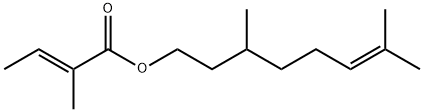
Citronellyl tiglate , 99.9% , 24717-85-9
Update time: 2023-04-23
PRODUCT Properties
| Boiling point: | 144-145 °C9 mm Hg(lit.) |
| Density | 0.903 g/mL at 25 °C(lit.) |
| vapor pressure | 1.4Pa at 25℃ |
| refractive index | n |
| FEMA | 4295 | CITRONELLYL TRANS-2-METHYL-2-BUTENOATE |
| Flash point: | >230 °F |
| color | A colourless or pale straw-coloured liquid. |
| Odor | Fresh-herbaceous, slightly green and warm-rosy odor of moderate tenacity. |
| Odor Type | floral |
| Water Solubility | 385μg/L at 20℃ |
| JECFA Number | 1823 |
| Cosmetics Ingredients Functions | PERFUMING |
| InChI | 1S/C15H26O2/c1-6-14(5)15(16)17-11-10-13(4)9-7-8-12(2)3/h6,8,13H,7,9-11H2,1-5H3/b14-6+ |
| InChIKey | UCFQYMKLDPWFHZ-MKMNVTDBSA-N |
| SMILES | O(CCC(CCC=C(C)C)C)C(=O)\C(=C\C)\C |
| LogP | 5.99 at 25℃ |
| NIST Chemistry Reference | Citronellyl tiglate(24717-85-9) |
| EPA Substance Registry System | 2-Butenoic acid, 2-methyl-, 3,7-dimethyl-6-octenyl ester, (2E)- (24717-85-9) |
Description and Uses
Rarely offered commercially, Citronellyl tiglate has been suggested for use in floral and herbaceous fragrances, including better soap perfumes. It has considerable power and good effect in i soap, but there are many related chemicals, some less expensive, others more freely available, with similar effects.
Safety
| Symbol(GHS) |   GHS07,GHS09 |
| Signal word | Warning |
| Hazard statements | H302-H412-H410-H317 |
| Precautionary statements | P264-P270-P301+P312-P330-P501-P273-P501-P261-P272-P280-P302+P352-P333+P313-P321-P363-P501-P273-P391-P501 |
| WGK Germany | 2 |
| TSCA | TSCA listed |
| Storage Class | 10 - Combustible liquids |
| Hazard Classifications | Aquatic Acute 1 Aquatic Chronic 1 Skin Sens. 1 |
| Toxicity | Both the acute oral LD50 value in rats and the acute dermal LD50 value in rabbits exceeded 5 g/kg (Moreno, 1975). |
| REACH Registrations | Active |