PRODUCT Properties
| Boiling point: | 1379℃[at 101 325 Pa] |
| Density | 1.49[at 20℃] |
| vapor pressure | 0Pa at 25℃ |
| Water Solubility | 22.67g/L at 20℃ |
| InChIKey | BRZPIOXDFJITBK-FVFGOVLKSA-N |
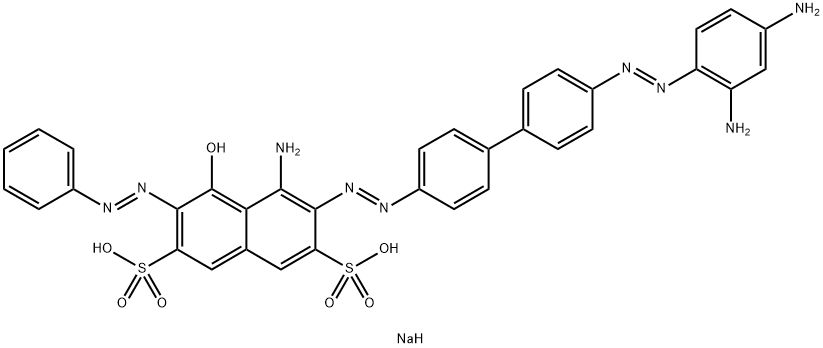
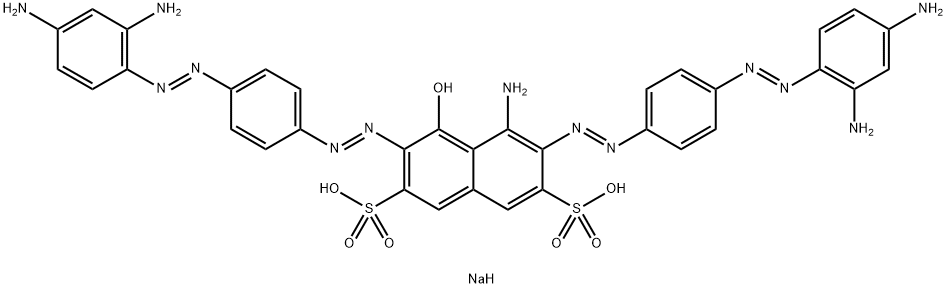
| SMILES | NC1=C(C(S(O)(=O)=O)=CC2=CC(S(O)(=O)=O)=C(/N=N/C3C=CC(/N=N/C4C=CC(N)=CC=4N)=CC=3)C(O)=C12)/N=N/C1C=CC(/N=N/C2C=CC(N)=CC=2N)=CC=1.[NaH] |
| LogP | -1.5 at 20℃ |
| CAS DataBase Reference | 6428-31-5(CAS DataBase Reference) |
| EPA Substance Registry System | C.I. Direct Black 19, disodium salt (6428-31-5) |
Description and Uses
Direct Black 19 is one of the main black dye varieties. It is primarily used for dyeing and direct printing on cotton, viscose fibers, and blends of cotton, viscose fibers, and silk or wool fabrics. It mainly dyes black, while gray and black are commonly used for printing. It can also be blended with brown dyes to create various shades of coffee, etc., and is used in small quantities for color adjustment to broaden the color spectrum. When dyeing wool-viscose blended fabrics, it can be dyed in the same bath as Neutral Black BRL for uniform color. It can also be used in the same bath as disperse dyes to dye polyester-viscose blended fabrics. It has good dye uptake but slightly poor migration. After dyeing, it can be treated with fixing agents Y and M, but the color has a slightly greenish hue. Finishing with urea-formaldehyde resin can maintain the color and improve wet fastness.
Safety
| Symbol(GHS) |  GHS07 |
| Signal word | Warning |
| Hazard statements | H315-H335-H319 |
| Precautionary statements | P264-P280-P305+P351+P338-P337+P313P-P264-P280-P302+P352-P321-P332+P313-P362 |
| TSCA | TSCA listed |
| Hazardous Substances Data | 6428-31-5(Hazardous Substances Data) |
| REACH Registrations | Active |