PRODUCT Properties
| Melting point: | 231-233 °C(lit.) |
| storage temp. | 2-8°C |
| solubility | H2O: 0.2 mg/mL Solubility increases with addition of 1 N NaOH. |
| form | powder |
| Cosmetics Ingredients Functions | ANTISTATIC SKIN CONDITIONING HAIR CONDITIONING |
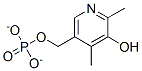
| InChI | InChI=1S/C8H12NO5P/c1-5-7(4-14-15(11,12)13)3-9-6(2)8(5)10/h3,10H,4H2,1-2H3,(H2,11,12,13)/p-2 |
| InChIKey | RBCOYOYDYNXAFA-UHFFFAOYSA-L |
| SMILES | C1(C)=NC=C(COP([O-])([O-])=O)C(C)=C1O |
| CAS DataBase Reference | 8059-24-3(CAS DataBase Reference) |
Description and Uses
Vitamin B6 (vitB6), or pyridoxine, is an important compound for general cellular metabolism. Since its discovery in 1934 by Gyrgy and colleagues, it has been implicated as a co-factor in more than 140 biochemical reactions in the cell. Although most vitB6 co-catalyzed reactions are related to amino acid biosynthesis and catabolism, vitB6 also contributes to fatty acid biosynthesis, breakdown of certain storage compounds in animals and plants, as well as in the biosynthesis of plant hormones, neurotransmitters, and organelle-specific compounds such as chlorophyll. In addition, vitamin B6 can quench reactive oxygen species (ROS). Because of its role in ROS scavenging and chlorophyll synthesis, vitamin B6 benefits photosynthesis and is discussed as a possible factor in alleviating abiotic and biotic stress. Vitamin B6 (pyridoxal 5′-phosphate) participates in the process of synthesizing dopamine, epinephrine, norepinephrine, serotonin and GABA. It has also been found to be an antioxidant.
Vitamin B6 comprises a group of six water-soluble compounds, including pyridoxal, pyridoxamine, pyridoxine, and their 5′-phosphates. It functions as a versatile coenzyme participating in over 100 biochemical reactions and is generally considered to have negligible toxicity due to its ready metabolism and excretion[1][2][3]. Vitamin B6 serves as a cofactor for approximately 160 reactions, including glycogen breakdown, amino acid transformations, and the synthesis of neurotransmitters such as GABA, dopamine, norepinephrine, and serotonin. Therapeutic administration is used to treat vitamin B6 deficiency (typically around 50 mg/day orally), prevent peripheral neuropathy induced by isoniazid, and manage nausea and vomiting during pregnancy[1][2][3][4].