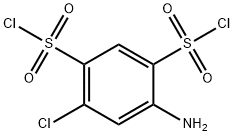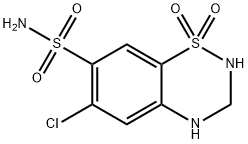
S1618249
n-Heptane , foranalysisEMSURE Reag.PhEur , 142-82-5
Synonym(s):
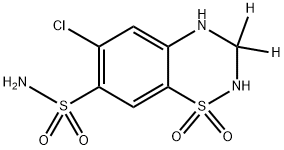
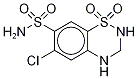
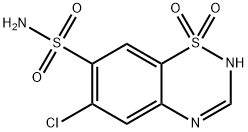
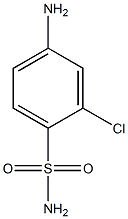
6-Chloro-3,4-dihydro-2H-1,2,4-benzothiadiazine-7-sulfonamide 1,1-dioxide;6-Chloro-7-sulfamyl-3,4-dihydro-1,2,4-benzothiadiazine 1,1-dioxide;HCTZ;Hydrochlorothiazide
CAS NO.:142-82-5
Empirical Formula: C7H8ClN3O4S2
Molecular Weight: 297.74
MDL number: MFCD00051765
EINECS: 200-403-3
| Pack Size | Price | Stock | Quantity |
| 1L | RMB732.52 | In Stock |
|
| 2.5L | RMB1526.09 | In Stock |
|
| 10L | RMB4981.17 | In Stock |
|
| 25L | RMB8872.69 | In Stock |
|
| 190L | RMB57376.73 | In Stock |
|
| others | Enquire |
Update time: 2022-07-08
PRODUCT Properties
| Melting point: | 273 °C |
| Boiling point: | 577.0±60.0 °C(Predicted) |
| Density | 1.6761 (rough estimate) |
| refractive index | 1.6100 (estimate) |
| Flash point: | 9℃ |
| storage temp. | 2-8°C |
| solubility | Very slightly soluble in water, soluble in acetone, sparingly soluble in ethanol (96 per cent). It dissolves in dilute solutions of alkali hydroxides |
| pka | 7.9, 9.2(at 25℃) |
| form | solid |
| color | White to Off-White |
| Odor | wh. or pract. wh. cryst. powd., odorless |
| Water Solubility | 722mg/L(25 ºC) |
| λmax | 318nm(H2O)(lit.) |
| Merck | 14,4781 |
| BRN | 625101 |
| BCS Class | 3,4 |
| Stability: | Stable. Incompatible with strong oxidizing agents. |
| Major Application | pharmaceutical (small molecule) |
| InChI | 1S/C7H8ClN3O4S2/c8-4-1-5-7(2-6(4)16(9,12)13)17(14,15)11-3-10-5/h1-2,10-11H,3H2,(H2,9,12,13) |
| InChIKey | JZUFKLXOESDKRF-UHFFFAOYSA-N |
| SMILES | NS(=O)(=O)c1cc2c(NCNS2(=O)=O)cc1Cl |
| LogP | -0.070 |
| CAS DataBase Reference | 58-93-5(CAS DataBase Reference) |
| NIST Chemistry Reference | 6-Chloro-7-sulfamyl-3,4-dihydro-1,2,4-benzothiadiazine-1,1-dioxide(58-93-5) |
| IARC | 2B (Vol. 50, 108) 2016 |
| EPA Substance Registry System | Hydrochlorothiazide (58-93-5) |
Description and Uses
Hydrochlorothiazide is one of the most widely used drugs of this series, and it is used for the same indications, as is chlorothiazide. Hydrochlorothiazide causes less inhibition of carbonic anhydrase, but causes 5–10 times more diuresis of sodium ions than chlorothiazide using the same dose.
Safety
| Symbol(GHS) |  GHS07 |
| Signal word | Warning |
| Hazard statements | H302 |
| Precautionary statements | P301+P312+P330 |
| PPE | Eyeshields, Gloves, type N95 (US) |
| Hazard Codes | Xi,T,F,Xn |
| Risk Statements | 22-42/43-36/38-23/25-36/37/38-39/23/24/25-23/24/25-11 |
| Safety Statements | 22-24-36/37-45-33-16-7-36/37/39-27-26 |
| RIDADR | UN 1230 3/PG 2 |
| WGK Germany | 2 |
| RTECS | DK9100000 |
| Hazard Note | Irritant |
| TSCA | TSCA listed |
| HS Code | 29350090 |
| Storage Class | 11 - Combustible Solids |
| Hazard Classifications | Carc. 2 |
| Hazardous Substances Data | 58-93-5(Hazardous Substances Data) |
| Toxicity | LD50 in mice (mg/kg): 590 i.v.; >8000 orally (Piala) |