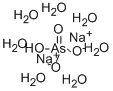
Arsenic solution , analyticalstandard,100mg/LinH2SO4 , 7440-38-2
Synonym(s):
Arsenic black;Arsenic-75;AS006125
CAS NO.:7440-38-2
Empirical Formula: AsH3
Molecular Weight: 77.95
MDL number: MFCD00085309
EINECS: 231-148-6
PRODUCT Properties
| Melting point: | 817 °C(lit.) |
| Boiling point: | 613 °C(lit.) |
| Density | 5.727 g/mL at 25 °C(lit.) |
| vapor pressure | 1Pa at 280℃ |
| storage temp. | 15-25°C |
| solubility | insoluble in H2O |
| form | powder |
| color | Silver to black |
| Specific Gravity | 5.727 |
| Odor | Odourless |
| PH | 2.5 (20°C in H2O) |
| Flame Color | Blue |
| Resistivity | 33.3 μΩ-cm |
| Water Solubility | insoluble |
| Sensitive | Air Sensitive |
| Merck | 13,802 |
| Exposure limits | TLV-TWA 0.2 mg(As)/m3 (ACGIH), 0.5 mg
(As)/m3 (MSHA), 0.01 mg(As)m3 (OSHA);
ceiling 0.002 mg(As)/m3/15 min (NIOSH);
carcinogenicity: Human Sufficient Evidence
(IARC). |
| Stability: | Stable. Incompatible with acids, oxidizing agents, halogens. Heat and air-sensitive. |
| CAS DataBase Reference | 7440-38-2(CAS DataBase Reference) |
| IARC | 1 (Vol. 23, Sup 7, 100C) 2012 |
| NIST Chemistry Reference | Arsenic(7440-38-2) |
| EPA Substance Registry System | Arsenic (7440-38-2) |
Description and Uses
Arsenic is a metalloid of the nitrogen group. Two allotrope forms of elemental arsenic have been reported: yellow arsenic and grey arsenic, the latter being usually the more stable form. Arsenic readily oxidises in air to arsenic trioxide (As2O3). Arsenic is mostly found either in its native state or as arsenic sulfide in the form of realgar (As4S4) or orpiment (As2S3). Arsenic can exist in three different valence states (zerovalent, trivalent and pentavalent). Arsenic forms covalent bonds with carbon, oxygen and hydrogen. The toxicity varies widely and depends on the physical state of the compound and its absorption/elimination rate. Trivalent arsenics (As(III)) are derivatives of the arsenous acid (H2AsO3-arsenite) and arsenic trioxide (AsO3). Examples of pentavalent arsenic (As(V)) include derivatives of the arsenic acid (H3AsO4 -arsenate). Organic arsenic-based compounds, that is, compounds containing arsenic-carbon bonds, are usually less toxic than their inorganic counterparts. This is mainly due to their quicker excretion from the human body. Arsenic is known to be one of the most toxic heavy metals. Compounds containing arsenic have a long history of use as poisons, but they also have a long historical medicinal use.
Arsenic is a brittle solid with a metallic coloring that ranges from silver to gray. It is a naturally occurring element found in the earth’s crust, and it cycles rapidly through water, land, air, and living systems. Exposure to it occurs through ingestion, inhalation, and dermal contact.
The arsenic metalloid is used for hardening copper and lead alloys (HSDB, 2005). It is also used in glass manufacturing as a decolorizing and refining agent, as a component of electrical devices in the semiconductor industry, and as a catalyst in the production of ethylene oxide. Arsenic compounds are used as a mordant in the textile industry, for preserving hides, as medicinals, pesticides, pigments, and wood preservatives. The production of chromate copper arsenate (CCA), a wood preservative, accounts for approximately 90% of the domestic arsenic consumption (ATSDR, 2007). However, production of this preservative is being phased out. The uses of inorganic arsenical compounds (e.g., lead arsenate) as pesticides were voluntarily cancelled by the industry during late 1980s and early 1990s. A majority of organoarsenicals are used on cotton and turf as herbicides. disodium methanearsenate (DSMA), monosodium methanearsenate (MSMA), and calcium methanearsenate (CAMA) continue to be used as contact herbicides.
Safety
| Symbol(GHS) |     GHS05,GHS06,GHS08,GHS09 |
| Signal word | Danger |
| Hazard statements | H301+H331-H315-H318-H350-H410 |
| Precautionary statements | P273-P280-P301+P310-P302+P352-P304+P340+P311-P305+P351+P338 |
| Hazard Codes | T,N |
| Risk Statements | 23/25-50/53-36/38-22-45-52/53-51/53 |
| Safety Statements | 20/21-28-45-60-61-26-53 |
| OEL | Ceiling: 0.002 mg/m3 [15-minute] |
| RIDADR | UN 1558 6.1/PG 2 |
| WGK Germany | 3 |
| RTECS | CG0525000 |
| F | 10 |
| TSCA | Yes |
| HazardClass | 6.1 |
| PackingGroup | II |
| HS Code | 28048000 |
| Hazardous Substances Data | 7440-38-2(Hazardous Substances Data) |
| Toxicity | Human exposure occurs occupationally and via food, tobacco smoke, ambient air, and water. Three major groups of arsenic compounds have been defined on the basis of biological considerations: inorganic arsenicals; organic arsenicals; and arsine (gas). The comparative toxicity of these groups is dependent upon the route of exposure and their solubilities; the more quickly absorbed compounds have lower LD50. Arsenic is readily absorbed by the respiratory and gastrointestinal systems and is concentrated in the skin, hair, and nails (Aldrich-Mees’ lines). The cellular toxicity of arsenic is related to reactions with SH-containing mitochondrial enzymes that result in impaired respiration. Arsenic may also compete with phosphate during oxidative phosphorylation. |
| IDLA | 5 mg As/m3 |