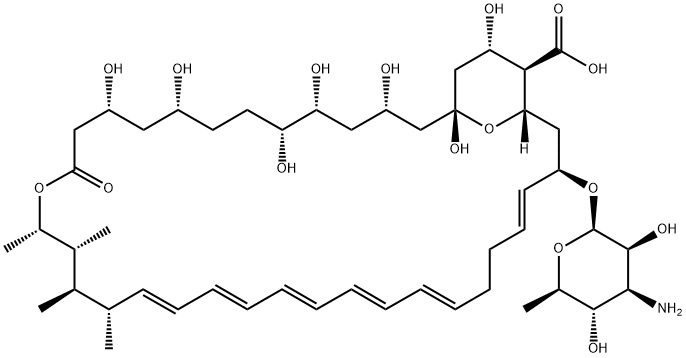
Amphotericin B , 80%,750μg/mg , 1397-89-3
Synonym(s):
Amphotericin;Amphotericin B;Amphotericin B from Streptomyces sp.;Fungizone
CAS NO.:1397-89-3
Empirical Formula: C47H73NO17
Molecular Weight: 924.08
MDL number: MFCD00877763
EINECS: 215-742-2
| Pack Size | Price | Stock | Quantity |
| 250MG | RMB39.20 | In Stock |
|
| 1G | RMB64.00 | In Stock |
|
| 5G | RMB256.00 | In Stock |
|
| others | Enquire |
PRODUCT Properties
| Melting point: | >170°C |
| alpha | D24 +333° (acidic DMF); -33.6° (0.1N methanolic HCl) |
| Boiling point: | 804.34°C (rough estimate) |
| Density | 1.34 |
| refractive index | 1.5280 (estimate) |
| storage temp. | 2-8°C |
| solubility | sterile water: 20 mg/mL as a stock solution. Stock solutions should be stored at −20°C. Stable at 37°C for 3 days. |
| pka | pKa ~5.7(DMF/H2O) (Uncertain) |
| form | powder |
| color | yellow |
| Water Solubility | <0.1 g/100 mL at 21 ºC |
| Sensitive | Moisture & Light Sensitive |
| Merck | 13,590 |
| BRN | 78342 |
| Stability: | Stable, but may be light sensitive. Incompatible with strong oxidizing agents. |
| InChIKey | APKFDSVGJQXUKY-INPOYWNPSA-N |
| CAS DataBase Reference | 1397-89-3(CAS DataBase Reference) |
| EPA Substance Registry System | Amphotericin B (1397-89-3) |
Description and Uses
Amphotericin B (1397-89-3) is a powerful antimycotic, effective against a wide variety of fungi, including yeast, via two mechanisms: forming pores in the plasma membrane, leading to leakage and death1, and causing oxidative stress2. Other mechanisms have more recently been proposed, including formation of intracellular amphotericin B-containing vesicular bodies that target vacuoles.3 Amphotericin B is also effective against some parasites, such as Leishmania spp.4 Because of its potency and broad-spectrum activity, it is a common additive used to maintain sterility in cell culture and viral transport media.
Amphotericin B (Funizone) is an antifungal macrolide antibiotic produced by Streptomyces nodosus that has been used as an alternative, albeit more toxic, drug to the antimonials. See also Amebiasis (Amebic Dysentery) . It acts as a leishmanicide against the visceral and mucocutaneous forms of the disease. To overcome its potentially severe nephrotoxicity, the drug must be administered over an extended period of time.
Safety
| Symbol(GHS) |  GHS08 |
| Signal word | Danger |
| Hazard statements | H372 |
| Precautionary statements | P260-P264-P270-P314-P501 |
| Hazard Codes | C,Xi,Xn,T |
| Risk Statements | 36/37/38-22-40-23/24/25 |
| Safety Statements | 26-36/37/39-45-36-60-37 |
| RIDADR | UN 1759 8/PG 3 |
| WGK Germany | 3 |
| RTECS | BU2625000 |
| F | 8-10-21 |
| HazardClass | 6.1(b) |
| PackingGroup | III |
| HS Code | 29419090 |
| Storage Class | 6.1C - Combustible acute toxic Cat.3 toxic compounds or compounds which causing chronic effects |
| Hazard Classifications | STOT RE 1 |
| Hazardous Substances Data | 1397-89-3(Hazardous Substances Data) |
| Toxicity | LD50 in mice (mg/kg): 88 i.p., 4 i.v. (Keim) |