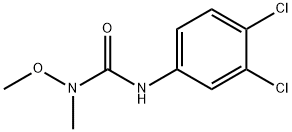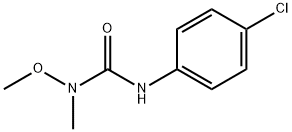
MonolinuronSolutioninMethanol , 1000 μg/mlinmethanol, uncertainty 2% , 1746-81-2
CAS NO.:1746-81-2
Empirical Formula: C9H11ClN2O2
Molecular Weight: 214.65
MDL number: MFCD00055264
EINECS: 217-129-5
| Pack Size | Price | Stock | Quantity |
| 1.2ml | RMB239.20 | In Stock |
|
| others | Enquire |
PRODUCT Properties
| Melting point: | 81.5℃ |
| Density | 1.3575 (rough estimate) |
| refractive index | 1.5790 (estimate) |
| Flash point: | 100 °C |
| storage temp. | Sealed in dry,Room Temperature |
| pka | 12.80±0.70(Predicted) |
| form | solid |
| color | White to Light yellow to Light orange |
| Water Solubility | 0.58g/L(room temperature) |
| BRN | 2212523 |
| Henry's Law Constant | 2.1×10² mol/(m3Pa) at 25℃, HSDB (2015) |
| InChI | InChI=1S/C9H11ClN2O2/c1-12(14-2)9(13)11-8-5-3-7(10)4-6-8/h3-6H,1-2H3,(H,11,13) |
| InChIKey | LKJPSUCKSLORMF-UHFFFAOYSA-N |
| SMILES | N(OC)(C)C(NC1=CC=C(Cl)C=C1)=O |
| EPA Substance Registry System | Monolinuron (1746-81-2) |
Description and Uses
Monolinuron is a herbicide that is not widely approved for use in the developed world. It has a low to moderate mammalian oral toxicity. It is moderately soluble in water and many organic solvents, and is volatile. Monolinuron has a high leaching potential and studies suggest that it is moderately persistent in soils. It is moderately toxic to birds, fish, aquatic invertebrates, aquatic plants and earthworms. It is relatively less toxic to honeybees.
The certified reference material (CRM) is intended to be used as a calibrant for chromatography and other analytical techniques.
Monolinuron CRM may also be used as given below:
- Determination of 252 pesticides extracted from surface water samples by solid-phase extraction (SPE) using liquid chromatography quadrupole-orbitrap high-resolution tandem mass spectrometry
- Extraction of 13 pesticides from four groundwater and three river water samples using silica-based MSU-1 mesoporous solid as a sorbent for their solid-phase extraction (SPE) followed by ultra-performance liquid chromatography-triple quadrupole-mass spectrometric (UHPLC- QqQ-MS/MS) determination
- Development and validation of a UHPLC-diode array detection (DAD) method for simultaneous determination of urea and tebuthiuron herbicides in four fresh vegetable samples
- Multi-residue analysis of 50 herbicides in 51 grain samples of soybean, corn, and whe at by ultra-performance liquid chromatography-electrospray ionization-mass spectrometry (UPLC-ESI-MS)
- Extraction of 109 pesticide residues from different chemical classes from 345 tomato samples by modified QuEChERS method and their determination using liquid chromatography-tandem mass spectrometry (LC-MS/MS)
- Simultaneous analysis of 238 pesticides and 78 veterinary drugs in 80 bovine milk samples using ultra-fast liquid chromatography-tandem mass spectrometry (UFLC-MS/MS) and gas chromatography-tandem mass spectrometry (GC-MS/MS)
Safety
| Symbol(GHS) |    GHS07,GHS08,GHS09 |
| Signal word | Warning |
| Hazard statements | H302-H373-H410 |
| Precautionary statements | P260-P264-P270-P273-P301+P312-P314 |
| Hazard Codes | Xn,N |
| Risk Statements | 22-48/22-50/53 |
| Safety Statements | 22-60-61 |
| RIDADR | UN 3077 9/PG 3 |
| WGK Germany | 3 |
| RTECS | YS6425000 |
| TSCA | TSCA listed |
| HS Code | 29280000 |
| Storage Class | 11 - Combustible Solids |
| Hazard Classifications | Acute Tox. 4 Oral Aquatic Acute 1 Aquatic Chronic 1 STOT RE 2 |
| Hazardous Substances Data | 1746-81-2(Hazardous Substances Data) |