A0801412
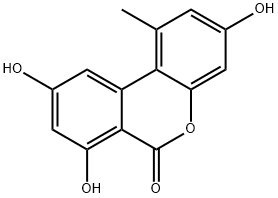
Alternariol , 96% , 641-38-3
Synonym(s):
3,7,9-Trihydroxy-1-methyl-6H-dibenzo[b,d]pyran-6-one;3,7,9-Trihydroxy-1-methyl-6H-dibenzo[b,d]pyran-6-one;3,7,9-Trihydroxy-1-methyl-benzo[c]chromen-6-one
| Pack Size | Price | Stock | Quantity |
| 1MG | RMB791.20 | In Stock |
|
| 5MG | RMB3199.20 | In Stock |
|
| others | Enquire |
Update time: 2022-07-08
PRODUCT Properties
| Melting point: | 350°C (rough estimate) |
| Boiling point: | 321.48°C (rough estimate) |
| Density | 1.2211 (rough estimate) |
| refractive index | 1.4560 (estimate) |
| storage temp. | 2-8°C |
| solubility | ≤0.5mg/ml in ethanol;30mg/ml in DMSO;30mg/ml in dimethyl formamide |
| pka | 7.16±0.20(Predicted) |
| form | Solid |
| color | Off-white to brown |
| BRN | 244839 |
| Stability: | Hygroscopic |
| Major Application | cleaning products cosmetics food and beverages personal care |
| InChI | 1S/C14H10O5/c1-6-2-7(15)5-11-12(6)9-3-8(16)4-10(17)13(9)14(18)19-11/h2-5,15-17H,1H3 |
| InChIKey | CEBXXEKPIIDJHL-UHFFFAOYSA-N |
| SMILES | Cc1cc(O)cc2OC(=O)c3c(O)cc(O)cc3-c12 |
Description and Uses
Alternariol is a mycotoxin, a toxic secondary fungal metabolite, produced by Alternaria molds. It is cytotoxic, fetotoxic, teratogenic, mutagenic, and genotoxic. It induces cytochrome P450 1A1 expression and apoptosis in mouse hepatoma cells (20-
An alternaria mycotoxin and genotoxin, found in common edible crops. It inhibits the activity of various DNA-topoisomerases, increasing he rate of DNA strand breaks.
Safety
| Symbol(GHS) |  GHS06 |
| Signal word | Danger |
| Hazard statements | H300+H310+H330 |
| Precautionary statements | P262-P280-P301+P310+P330-P302+P352+P310-P304+P340+P310 |
| Hazard Codes | T+ |
| Risk Statements | 26/27/28 |
| Safety Statements | 28-36/37/39-45 |
| RIDADR | UN 3462 6.1/PG 1 |
| WGK Germany | 3 |
| RTECS | HP8757000 |
| HazardClass | 6.1(b) |
| PackingGroup | III |
| HS Code | 29322090 |
| Storage Class | 6.1A - Combustible acute toxic Cat. 1 and 2 very toxic hazardous materials |
| Hazard Classifications | Acute Tox. 1 Inhalation Acute Tox. 2 Dermal Acute Tox. 2 Oral |
| Toxicity | LDLo intraperitoneal in mouse: 100mg/kg |