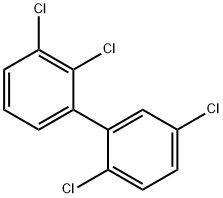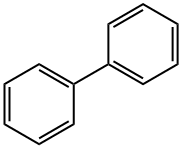
Biphenyl , Analysis standard , 92-52-4
Synonym(s):
Biphenyl
CAS NO.:92-52-4
Empirical Formula: C12H10
Molecular Weight: 154.21
MDL number: MFCD00003054
EINECS: 202-163-5
PRODUCT Properties
| Melting point: | 68-70 °C (lit.) |
| Boiling point: | 255 °C (lit.) |
| bulk density | 600kg/m3 |
| Density | 0.992 |
| vapor density | 5.31 (vs air) |
| vapor pressure | 9.46 mm Hg ( 115 °C) |
| refractive index | 1.475 |
| FEMA | 3129 | BIPHENYL |
| Flash point: | 113 °C |
| storage temp. | Store below +30°C. |
| solubility | Soluble in alcohol and ether |
| form | Crystalline Powder, Crystals or Flakes |
| color | White to faint yellow |
| Specific Gravity | 0.992 |
| Odor | pleasant odor |
| Odor Type | green |
| biological source | synthetic |
| explosive limit | 0.6%, 111°F |
| Water Solubility | insoluble |
| Specific Heat Capacity | Cp(crystal): 1.29 J/(g·K), at 25℃ |
| ex/em | λex 247 nm; λem 326, 313, 303 nm in cyclohexane |
| JECFA Number | 1332 |
| Merck | 14,3314 |
| BRN | 1634058 |
| Henry's Law Constant | 2.92 at 25 °C (air stripping-GC, Destaillats and Charles, 2002) |
| Exposure limits | ACGIH:TLV-TWA 0.2 ppm (1.3 mg/m3) OSHA:PEL-TWA 0.2 ppm (1 mg/m3) NIOSH:REL-TWA 0.2 ppm |
| Dielectric constant | 20.0(Ambient) |
| Stability: | Stable. Combustible. Incompatible with strong oxidising agents. |
| Major Application | agriculture cleaning products cosmetics environmental food and beverages personal care |
| InChI | 1S/C12H10/c1-3-7-11(8-4-1)12-9-5-2-6-10-12/h1-10H |
| InChIKey | ZUOUZKKEUPVFJK-UHFFFAOYSA-N |
| SMILES | c1ccc(cc1)-c2ccccc2 |
| LogP | 4.008 at 25℃ |
| CAS DataBase Reference | 92-52-4(CAS DataBase Reference) |
| NIST Chemistry Reference | Biphenyl(92-52-4) |
| EPA Substance Registry System | Biphenyl (92-52-4) |
Description and Uses
Biphenyl is an organic compound with chemical formula of C12H10. It is a white crystalline powder, insoluble in water, soluble in ether, ethanol, carbon tetrachloride, dioxane, aromatic hydrocarbons, etc. it is mainly used as solvent, heat transfer agent, fruit mildew inhibitor and organic synthesis.
Biphenyl is used as an antifungal agent to preserve citrus fruit, in citrus wrappers to retard mold growth, in heat transfer fluids, in dye carriers for textiles and copying paper, as a solvent in pharmaceutical production, in optical brighteners, and as an intermediate for the production of a wide range of organic compounds.
Safety
| Symbol(GHS) |    GHS07,GHS08,GHS09 |
| Signal word | Danger |
| Hazard statements | H303+H313-H315-H319-H372-H373-H335-H410 |
| Precautionary statements | P501-P273-P260-P270-P271-P264-P280-P302+P352-P312-P391-P337+P313-P305+P351+P338-P362+P364-P332+P313-P304+P340+P312-P403+P233-P405 |
| target organs | Respiratory system |
| PPE | dust mask type N95 (US), Eyeshields, Gloves |
| Hazard Codes | Xi,N,Xn,F,T |
| Risk Statements | 36/37/38-50/53-67-65-62-48/20-11-39/23/24/25-23/24/25-52/53 |
| Safety Statements | 23-60-61-62-36/37-33-29-16-9-45 |
| RIDADR | UN 3077 9/PG 3 |
| OEB | C |
| OEL | TWA: 1 mg/m3 (0.2 ppm) |
| WGK Germany | 2 |
| RTECS | DU8050000 |
| Autoignition Temperature | 570 °C |
| TSCA | TSCA listed |
| HazardClass | 9 |
| PackingGroup | III |
| HS Code | 29029030 |
| Storage Class | 13 - Non Combustible Solids |
| Hazard Classifications | Aquatic Acute 1 Aquatic Chronic 1 Eye Irrit. 2 Skin Irrit. 2 STOT SE 3 |
| Hazardous Substances Data | 92-52-4(Hazardous Substances Data) |
| Toxicity | LD50 orally in rats: 3280 mg/kg (Deichmann) |
| IDLA | 100 mg/m3 |
| REACH Registrations | Active |
| Limited Quantities | 5.0 kg (11 lbs) (solid) |
| Excepted Quantities | Max Inner Pack (30g or 30ml) and Max Outer Pack (1Kg or 1L) |