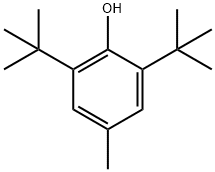
2,6-Di-tert-butyl-4-methylphenol , Analysis of standard products,> 99.7%(GC) , 128-37-0
Synonym(s):
BHT;Butylated hydroxytoluene;2,6-Di-tert-butyl-4-methylphenol;Butylhydroxytoluene;DBPC
CAS NO.:128-37-0
Empirical Formula: C15H24O
Molecular Weight: 220.35
MDL number: MFCD00011644
EINECS: 204-881-4
| Pack Size | Price | Stock | Quantity |
| 1G | RMB108.80 | In Stock |
|
| others | Enquire |
PRODUCT Properties
| Melting point: | 69-73 °C(lit.) |
| Boiling point: | 265 °C(lit.) |
| bulk density | 450kg/m3 |
| Density | 1.048 |
| vapor density | 7.6 (vs air) |
| vapor pressure | <0.01 mm Hg ( 20 °C) |
| FEMA | 2184 | BUTYLATED HYDROXYTOLUENE |
| refractive index | 1.4859 |
| Flash point: | 127 °C |
| storage temp. | 2-8°C |
| solubility | methanol: 0.1 g/mL, clear, colorless |
| pka | pKa 14(H2O
t = 25
c = 0.002 to 0.01) (Uncertain) |
| form | Crystals |
| color | white |
| Odor | faint characteristic odor |
| biological source | synthetic |
| Odor Type | phenolic |
| Water Solubility | insoluble |
| Merck | 14,1548 |
| BRN | 1911640 |
| Henry's Law Constant | 2.9×10⁻³ mol/(m3Pa) at 25℃, Yoshida et al. (1983) |
| Exposure limits | ACGIH: TWA 2 mg/m3 NIOSH: TWA 10 mg/m3 |
| Stability: | Stable, but light-sensitive. Incompatible with acid chlorides, acid anhydrides, brass, copper, copper alloys, steel, bases, oxidizing agents. Combustible. |
| Major Application | flavors and fragrances |
| Cosmetics Ingredients Functions | ANTIOXIDANT FRAGRANCE |
| Cosmetic Ingredient Review (CIR) | Butylated Hydroxytoluene (128-37-0) |
| InChI | 1S/C15H24O/c1-10-8-11(14(2,3)4)13(16)12(9-10)15(5,6)7/h8-9,16H,1-7H3 |
| InChIKey | NLZUEZXRPGMBCV-UHFFFAOYSA-N |
| SMILES | Cc1cc(c(O)c(c1)C(C)(C)C)C(C)(C)C |
| LogP | 5.2 |
| CAS DataBase Reference | 128-37-0(CAS DataBase Reference) |
| IARC | 3 (Vol. 40, Sup 7) 1987 |
| NIST Chemistry Reference | Butylated hydroxytoluene(128-37-0) |
| EPA Substance Registry System | 2,6-Di-tert-butyl-p-cresol (128-37-0) |
Description and Uses
Butylated hydroxytoluene (BHT) is a synthetic antioxidant. It scavenges peroxide, 2,2-diphenyl-1-picrylhydrazyl (DPPH; ), superoxide, and ABTS radicals in cell-free assays, as well as inhibits lipid peroxidation of linoleic acid in vitro when used at a concentration of 45 μg/ml. Butylated Hydroxytoluene (0.025-3.2 mM) reduces freeze-thaw-induced malondialdehyde (MDA) production and increases sperm viability in boar spermatozoa preparations. Formulations containing BHT have been used as antioxidant cosmetic and food additives.
Because they prevent rancidity, antioxidants are of great interest to the food industry. For example, butylated hydroxytoluene (BHT), butylated hydroxyanisole (BHA), and EDTA are frequently used to preserve various foods, such as cheese or fried products. Butylated hydroxytoluene is a powerful inhibitor of lipid peroxidation, yet large doses of it can induce oxidative DNA damage and cancer development in the rat forestomach.
Safety
| Symbol(GHS) |  GHS09 |
| Signal word | Warning |
| Hazard statements | H410 |
| Precautionary statements | P273-P391-P501 |
| PPE | dust mask type N95 (US), Eyeshields, Gloves |
| Hazard Codes | Xn,N |
| Risk Statements | 22-36/37/38-36/38-50/53 |
| Safety Statements | 26-36-37/39-61-60 |
| RIDADR | 3077 |
| OEB | B |
| OEL | TWA: 10 mg/m3 |
| WGK Germany | 1 |
| RTECS | GO7875000 |
| F | 8-10-23 |
| Autoignition Temperature | 878 °F |
| TSCA | TSCA listed |
| HazardClass | 9 |
| PackingGroup | III |
| HS Code | 29071900 |
| Storage Class | 11 - Combustible Solids |
| Hazard Classifications | Aquatic Acute 1 Aquatic Chronic 1 |
| Hazardous Substances Data | 128-37-0(Hazardous Substances Data) |
| Toxicity | LD50 orally in mice: 1040 mg/kg (McOmie) |
| REACH Registrations | Active |