
A3207912
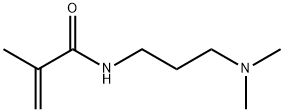
DMAPMA , 98% , 5205-93-6
Synonym(s):
N ,N -Dimethylaminopropyl methacrylamide;N -[3-(N ,N -Dimethylamino)propyl]methacrylamide
CAS NO.:5205-93-6
Empirical Formula: C9H18N2O
Molecular Weight: 170.25
MDL number: MFCD00038359
EINECS: 226-002-3
| Pack Size | Price | Stock | Quantity |
| 25ML | RMB36.80 | In Stock |
|
| 100ML | RMB81.60 | In Stock |
|
| 500ML | RMB275.20 | In Stock |
|
| others | Enquire |
Update time: 2022-07-08
PRODUCT Properties
| Melting point: | <-60°C |
| Boiling point: | 134 °C2 mm Hg(lit.) |
| Density | 0.94 g/mL at 25 °C(lit.) |
| vapor pressure | 0.4Pa at 19.85℃ |
| refractive index | n |
| Flash point: | >230 °F |
| storage temp. | 2-8°C(protect from light) |
| pka | 15.01±0.46(Predicted) |
| form | Liquid |
| Specific Gravity | 0.94 |
| Appearance | Colorless to light yellow Liquid |
| InChI | InChI=1S/C9H18N2O/c1-8(2)9(12)10-6-5-7-11(3)4/h1,5-7H2,2-4H3,(H,10,12) |
| InChIKey | GDFCSMCGLZFNFY-UHFFFAOYSA-N |
| SMILES | C(NCCCN(C)C)(=O)C(C)=C |
| LogP | 0.5 at 20℃ |
| CAS DataBase Reference | 5205-93-6(CAS DataBase Reference) |
| EPA Substance Registry System | 2-Propenamide, N-[3-(dimethylamino)propyl]-2-methyl- (5205-93-6) |
Description and Uses
- Glucose-containing diblock polycations exhibit molecular weight, charge, and cell-type dependence for pDNA delivery.: This study investigates the use of glucose-containing diblock polycations, including N-[3-(Dimethylamino)propyl]methacrylamide, in pDNA delivery systems. The research demonstrates that the efficiency of pDNA delivery is influenced by the molecular weight and charge of the polycations, as well as the type of cell used. This highlights the potential for tailored gene delivery applications in different cell types, emphasizing the role of N-[3-(Dimethylamino)propyl]methacrylamide in creating biocompatible and effective delivery vectors (Wu et al., 2014).
N-[3-(Dimethylamino)propyl]Methacrylamide can be used:
- As a monomer to synthesize self-healing pH-responsive P(DMAPMA-stat-DAA) hydrogels for drug delivery applications.
- As a cationic monomer to develop gene delivery vector due to its ability to complex with nucleic acids and facilitate their intracellular delivery.
- To fabricate iron oxide nanoparticle formulations for 3D printing. These iron inks are utilized for printing magnetic devices, MRI contrast agents for bioimaging and targeted drug delivery systems.
- To prepare a non-toxic synthetic flocculant for harvesting microalgae.
Safety
| Symbol(GHS) |   GHS05,GHS07 |
| Signal word | Danger |
| Hazard statements | H315-H317-H318 |
| Precautionary statements | P280-P305+P351+P338 |
| PPE | Eyeshields, Gloves, type ABEK (EN14387) respirator filter |
| Hazard Codes | Xi |
| Risk Statements | 36-38-43-41 |
| Safety Statements | 26-36/37/39 |
| WGK Germany | 1 |
| TSCA | TSCA listed |
| HS Code | 29241990 |
| Storage Class | 10 - Combustible liquids |
| Hazard Classifications | Eye Dam. 1 Skin Irrit. 2 Skin Sens. 1 |
| REACH Registrations | Active |
![[3-<WBR>(Methacryloylamino)<WBR>propyl]<WBR>trimethylammonium chloride solution](https://img.chemicalbook.com/CAS/GIF/51410-72-1.gif)
![[3-(Methacryloylamino)propyl]dimethyl(3-sulfopropyl)ammoniumhydroxideinnersalt](https://img.chemicalbook.com/CAS/GIF/5205-95-8.gif)