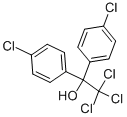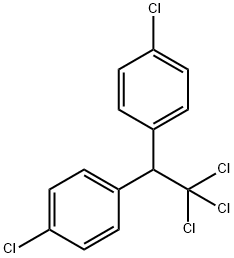
p,p’-DDT in methanol , analyticalstandard,50.0ug/mLinToluene:Methanol(volumeratio1:4) , 50-29-3
Synonym(s):
1,1,1-Trichloro-2,2-bis(4-chlorophenyl)ethane;1,1,1-Trichloro-2,2-bis(4-chlorophenyl)ethane solution;1,1-Bis(4-chlorophenyl)-2,2,2-trichloroethane;4,4′-DDT solution
CAS NO.:50-29-3
Empirical Formula: C14H9Cl5
Molecular Weight: 354.49
MDL number: MFCD00000802
EINECS: 200-024-3
PRODUCT Properties
| Melting point: | 107-110 °C(lit.) |
| Boiling point: | 440.74°C (rough estimate) |
| Density | 1.556 g/cm3 |
| vapor pressure | 0.5 at 25 °C (extrapolated from vapor pressures determined at higher temperatures, Tesconi andYalkowsky, 1998) |
| refractive index | 1.755 |
| Flash point: | 72 °C |
| storage temp. | APPROX 4°C |
| solubility | Chloroform: Slightly Soluble; Methanol: Heated |
| Water Solubility | Practically insoluble in water |
| Merck | 13,2861 |
| BRN | 1882657 |
| Henry's Law Constant | 0.188 at 5 °C, 0.513 at 15 °C, 0.681 at 20 °C, 0.957 at 25 °C, 2.76 at 35 °C:in 3% NaCl solution:
1.15 at 5 °C, 1.88 at 15 °C, 3.36 at 25 °C, 5.43 at 35 °C (gas stripping-GC, Cetin et al., 2006) |
| Exposure limits | ACGIH:TLV-TWA 1 mg/m3 OSHA:PEL-TWA 1 mg/m3 NIOSH:REL-TWA 0.5 mg/m3 |
| Stability: | Stable. Combustible. Incompatible with strong oxidizing agents, iron and aluminium and their salts, alkalies. |
| Major Application | agriculture environmental |
| InChI | 1S/C14H9Cl5/c15-11-5-1-9(2-6-11)13(14(17,18)19)10-3-7-12(16)8-4-10/h1-8,13H |
| InChIKey | YVGGHNCTFXOJCH-UHFFFAOYSA-N |
| SMILES | Clc1ccc(cc1)C(c2ccc(Cl)cc2)C(Cl)(Cl)Cl |
| IARC | 2A (Vol. Sup 7, 53, 113) 2018 |
| EPA Substance Registry System | p,p'-DDT (50-29-3) |
Description and Uses
DDT is a polychlorinated persistent chemical that exists as a solid under normal conditions.Even though DDT seemed to be a cheap and effective pesticide, enough was known in its early development to raise concerns. DDT is a persistent chemical that lasts a long time in the environment. DDT is fat-soluble and not readily metabolized by higher organisms. Th is meant that DDT accumulated in the fat tissues of higher organisms.
The primary use of DDT is as a vector control for eradication of malaria-bearing mosquitoes. Less persistent insecticides have replaced DDT for control of insects on crops and in forests.
Safety
| Symbol(GHS) |    GHS06,GHS08,GHS09 |
| Signal word | Danger |
| Hazard statements | H301-H351-H372-H410 |
| Precautionary statements | P264-P270-P201-P202-P280-P260-P273-P301+P310-P330-P308+P313-P314-P391-P405-P501 |
| target organs | Central nervous system |
| Hazard Codes | T,N,Xi,F,Xn |
| Risk Statements | 25-40-48/25-50/53-36/37/38-11-39/23/24/25-23/24/25-52/53-24-67-65-38 |
| Safety Statements | 22-36/37-45-60-61-36-33-26-16-7-62 |
| RIDADR | UN 2811 6.1/PG 3 |
| OEB | C |
| OEL | TWA: 0.5 mg/m3 |
| WGK Germany | 3 |
| RTECS | KJ3325000 |
| TSCA | TSCA listed |
| HazardClass | 6.1(b) |
| PackingGroup | III |
| Storage Class | 3 - Flammable liquids |
| Hazard Classifications | Aquatic Acute 1 Aquatic Chronic 1 Asp. Tox. 1 Flam. Liq. 2 Skin Irrit. 2 STOT SE 3 |
| Hazardous Substances Data | 50-29-3(Hazardous Substances Data) |
| Toxicity | LD50 in male, female rats (mg/kg): 113, 118 orally (Gaines, 1960) |
| IDLA | 500 mg/m3 |