A3672556
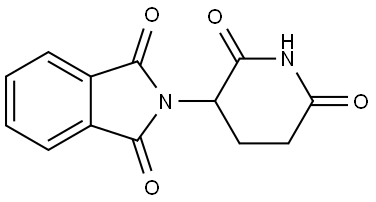
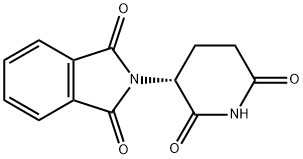
(R)-(+)-Thalidomide , ≥98% , 2614-06-4
Synonym(s):
R-(+)-2-(2,6-Dioxo-3-piperidinyl)-1H-isoindole-1,3(2H)-dione
| Pack Size | Price | Stock | Quantity |
| 10mg | RMB514.40 | In Stock |
|
| 5mg | RMB559.20 | In Stock |
|
| 25mg | RMB1919.20 | In Stock |
|
| others | Enquire |
Update time: 2022-07-08
PRODUCT Properties
| Melting point: | 269-271°C |
| Boiling point: | 401.48°C (rough estimate) |
| Density | 1.2944 (rough estimate) |
| refractive index | 1.5300 (estimate) |
| storage temp. | -20°C Freezer |
| solubility | DMSO: soluble |
| form | solid |
| pka | 10.70±0.40(Predicted) |
| color | white |
| InChI | 1S/C13H10N2O4/c16-10-6-5-9(11(17)14-10)15-12(18)7-3-1-2-4-8(7)13(15)19/h1-4,9H,5-6H2,(H,14,16,17)/t9-/m1/s1 |
| InChIKey | UEJJHQNACJXSKW-SECBINFHSA-N |
| SMILES | O=C1CC[C@@H](N2C(=O)c3ccccc3C2=O)C(=O)N1 |
Description and Uses
Thalidomide has been used to study its teratogenic effects in chicken embryos and human embryonic cells. This study reported that thalidomide causes limb defects by stabilizing PTEN, inhibiting the expression of Akt and activating caspase-dependent apoptosis. Thalidomide has also been used for studying glutathione mediated teratogenic resistance in mouse embryos.
Safety
| Symbol(GHS) |   GHS07,GHS08 |
| Signal word | Danger |
| Hazard statements | H302-H360 |
| Precautionary statements | P201-P301+P312+P330-P308+P313 |
| PPE | Eyeshields, Faceshields, Gloves, type P3 (EN 143) respirator cartridges |
| Hazard Codes | T |
| Risk Statements | 61-22 |
| Safety Statements | 53-36/37/39-45 |
| WGK Germany | 3 |
| RTECS | TI4925000 |
| Storage Class | 6.1C - Combustible acute toxic Cat.3 toxic compounds or compounds which causing chronic effects |
| Hazard Classifications | Acute Tox. 4 Oral Repr. 1B |