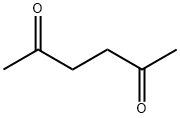
2,5-Hexanedione , 97% , 110-13-4
Synonym(s):
2,5-Hexanedione;Acetonylacetone
CAS NO.:110-13-4
Empirical Formula: C6H10O2
Molecular Weight: 114.14
MDL number: MFCD00008792
EINECS: 203-738-3
| Pack Size | Price | Stock | Quantity |
| 25ML | RMB39.20 | In Stock |
|
| 100ML | RMB112.80 | In Stock |
|
| 500ML | RMB440.00 | In Stock |
|
| 2.5L | RMB2047.20 | In Stock |
|
| others | Enquire |
PRODUCT Properties
| Melting point: | -6--5 °C (lit.) |
| Boiling point: | 191 °C (lit.) |
| Density | 0.973 g/mL at 25 °C (lit.) |
| vapor pressure | 0.43 mm Hg ( 20 °C) |
| refractive index | n |
| Flash point: | 174 °F |
| storage temp. | Store below +30°C. |
| solubility | alcohol: miscible; Miscible with water, ethylalcohol and ether,ess. oils and perfume materials. |
| form | Liquid |
| color | Clear yellow to brown |
| Odor | Pleasant, sweet-ethereal odor. |
| PH | 6.1 (10g/l, H2O, 20℃) |
| explosive limit | 1.5%(V) |
| Water Solubility | miscible |
| Merck | 14,71 |
| BRN | 506525 |
| Stability: | Stable. Incompatible with strong bases, strong reducing agents, strong oxidizing agents. Flammable. |
| Cosmetics Ingredients Functions | PERFUMING |
| InChI | 1S/C6H10O2/c1-5(7)3-4-6(2)8/h3-4H2,1-2H3 |
| InChIKey | OJVAMHKKJGICOG-UHFFFAOYSA-N |
| SMILES | CC(=O)CCC(C)=O |
| LogP | -0.270 |
| CAS DataBase Reference | 110-13-4(CAS DataBase Reference) |
| NIST Chemistry Reference | CH3COCH2CH2COCH3(110-13-4) |
| EPA Substance Registry System | 2,5-Hexanedione (110-13-4) |
Description and Uses
2, 5-hexadione (2,5-HD) is a flammable, transparent colorless to amber water-soluble liquid that is a multifunctional platform chemical, a major metabolite of n-hexane, and a key intermediate for the production of high energy density aviation fuels from biomass resources. It has a sweet aromatic smell and neurotoxic effects. It can be used as a high energy density fuel additive of platform chemicals, and can induce ovarian granulosa cell cycle arrest to establish ovarian injury model. It can also be used for biological monitoring of 2, 5-hexanedione exposure to n-hexane[1-2].
2,5-Hexanedione is used as a reagent in the preparation of trans-2,5-dimethylpyrrolidine. It is also used in the synthesis of 2,5-dimethylpyrroles. Further, it plays an important role as a reagent used for the protection of amino groups in amino sugars and nucleosides. In addition to this, it is used in the preparation of five-membered heterocycles like indane-type and benzannulated systems. It is also employed as a precursor in Diels-alder cycloaddition reactions.
Safety
| Symbol(GHS) |   GHS07,GHS08 |
| Signal word | Warning |
| Hazard statements | H302-H315-H319-H361f-H373 |
| Precautionary statements | P202-P260-P301+P312-P302+P352-P305+P351+P338-P308+P313 |
| target organs | Nervous system |
| Hazard Codes | Xn,Xi |
| Risk Statements | 36/38-48/20/21/22-36/37/38 |
| Safety Statements | 23-26-36/37-37/39 |
| WGK Germany | 2 |
| RTECS | MO3150000 |
| F | 8 |
| Autoignition Temperature | 400 °C |
| TSCA | TSCA listed |
| HS Code | 29141990 |
| Storage Class | 10 - Combustible liquids |
| Hazard Classifications | Acute Tox. 4 Oral Eye Irrit. 2 Repr. 2 Skin Irrit. 2 STOT RE 2 |
| Toxicity | LD50 orally in rats: 2.7 g/kg (Smyth, Carpenter) |
| REACH Registrations | Active |