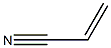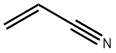
Acrylonitrile , 99%, containing cluster Mehq , 107-13-1
Synonym(s):
Acrylic acid nitrile, Vinyl cyanide;Acrylonitrile;Vinyl cyanide
CAS NO.:107-13-1
Empirical Formula: C3H3N
Molecular Weight: 53.06
MDL number: MFCD00001927
EINECS: 203-466-5
PRODUCT Properties
| Melting point: | -83 °C (lit.) |
| Boiling point: | 77 °C (lit.) |
| Density | 0.806 g/mL at 20 °C |
| vapor density | 1.83 (vs air) |
| vapor pressure | 86 mm Hg ( 20 °C) |
| refractive index | n |
| Flash point: | 32 °F |
| storage temp. | 2-8°C |
| solubility | 73g/l |
| form | Liquid |
| color | Clear |
| Odor | Mild pyridine-like odor at 2 to 22 ppm |
| PH | 6.0-7.5 (50g/l, H2O, 20℃) |
| Odor Threshold | 8.8ppm |
| explosive limit | 2.8-28%(V) |
| Water Solubility | Soluble. 7.45 g/100 mL |
| Thermal Conductivity | 0.166 W/(m·K) at 25 ℃ |
| Sensitive | Light Sensitive |
| Merck | 14,131 |
| BRN | 605310 |
| Henry's Law Constant | 1.30 at 30.00 °C (headspace-GC, Hovorka et al., 2002) |
| Dielectric constant | 33.009999999999998 |
| Exposure limits | ACGIH TLV-TWA:2 ppm (4.3 mg/m3) OSHA PEL-TWA:2 ppm,15-min;PEL-Ceiling:10 ppm NIOSH REL-TWA:1 ppm;REL-Ceiling:10 ppm[15 min];IDLH:85 ppm |
| Major Application | agriculture environmental |
| InChI | 1S/C3H3N/c1-2-3-4/h2H,1H2 |
| InChIKey | NLHHRLWOUZZQLW-UHFFFAOYSA-N |
| SMILES | C=CC#N |
| LogP | 0.017 at 21℃ |
| CAS DataBase Reference | 107-13-1(CAS DataBase Reference) |
| IARC | 2B (Vol. 71) 1999 |
| NIST Chemistry Reference | 2-Propenenitrile(107-13-1) |
| EPA Substance Registry System | Acrylonitrile (107-13-1) |
Description and Uses
Acrylonitrile is used in the production of acrylic fibers, resins, and surface coating; as an intermediate in the production of pharmaceuticals and dyes; as a polymer modifier; and as a fumigant. It may occur in fire-effluent gases because of pyrolyses of polyacrylonitrile materials. Acrylonitrile was found to be released from the acrylonitrile–styrene copolymer and acrylonitrile–styrene–butadiene copolymer bottles when these bottles were filled with food-simulating solvents such as water, 4% acetic acid, 20% ethanol, and heptane and stored for 10 days to 5 months (Nakazawa et al. 1984). The release was greater with increasing temperature and was attributable to the residual acrylonitrile monomer in the polymeric materials.
Safety
| Symbol(GHS) |      GHS02,GHS05,GHS06,GHS08,GHS09 |
| Signal word | Danger |
| Hazard statements | H310+H330-H301-H315-H318-H361-H370-H372-H317-H341-H350-H335-H411-H225 |
| Precautionary statements | P501-P273-P272-P270-P262-P202-P240-P260-P210-P233-P201-P243-P241-P242-P271-P264-P280-P284-P370+P378-P391-P308+P311-P361+P364-P303+P361+P353-P333+P313-P301+P310+P330-P304+P340+P310-P305+P351+P338+P310-P403+P233-P403+P235-P405 |
| Hazard Codes | F,T,N,Xn |
| Risk Statements | 45-11-23/24/25-37/38-41-43-51/53-39/23/24/25-62-63 |
| Safety Statements | 53-9-16-45-61-36/37 |
| RIDADR | UN 1093 (ACRYLONITRILE, STABILIZED) |
| OEB | D |
| OEL | TWA: 1 ppm, Ceiling: 10 ppm [15-minute] [skin] |
| WGK Germany | 3 |
| RTECS | AT5250000 |
| F | 8 |
| Autoignition Temperature | 481 °C |
| TSCA | TSCA listed |
| HazardClass | 3 |
| PackingGroup | I |
| HS Code | 29261000 |
| Hazardous Substances Data | 107-13-1(Hazardous Substances Data) |
| Toxicity | LD50 orally in rats: 0.093 g/kg (Smyth, Carpenter) |
| IDLA | 60 ppm |
| REACH Registrations | Active |