
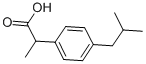
Ibuprofen , ≥98%(GC) , 15687-27-1
Synonym(s):
α-Methyl-4-(isobutyl)phenylacetic acid;(±)-2-(4-Isobutylphenyl)propanoic acid;[(±)-2-(4-Isobutylphenyl)-propionic Acid;IB;IBU
CAS NO.:15687-27-1
Empirical Formula: C13H18O2
Molecular Weight: 206.28
MDL number: MFCD00010393
EINECS: 239-784-6
| Pack Size | Price | Stock | Quantity |
| 5G | RMB23.20 | In Stock |
|
| 25G | RMB35.20 | In Stock |
|
| 100G | RMB80.80 | In Stock |
|
| 250g | RMB187.20 | In Stock |
|
| 500G | RMB278.40 | In Stock |
|
| 1kg | RMB543.20 | In Stock |
|
| others | Enquire |
PRODUCT Properties
| Melting point: | 77-78 °C |
| alpha | [α]D20 -1~+1°(c=1,C2H5OH) |
| Boiling point: | 157 °C (4 mmHg) |
| Density | 1.0364 (rough estimate) |
| refractive index | 1.5500 (estimate) |
| Flash point: | 9℃ |
| storage temp. | 2-8°C |
| solubility | Practically insoluble in water, freely soluble in acetone, in methanol and in methylene chloride. It dissolves in dilute solutions of alkali hydroxides and carbonates. |
| pka | pKa 4.45± 0.04(H2O,t = 25±0.5,I=0.15(KCl))(Approximate) |
| form | Crystalline Powder |
| color | white to off-white |
| biological source | synthetic (organic) |
| Water Solubility | insoluble |
| Merck | 14,4881 |
| Henry's Law Constant | 6.6×101 mol/(m3Pa) at 25℃, HSDB (2015) |
| BCS Class | 2 |
| Stability: | Stable. Combustible. Incompatible with strong oxidizing agents. |
| Cosmetics Ingredients Functions | SKIN CONDITIONING |
| InChI | 1S/C13H18O2/c1-9(2)8-11-4-6-12(7-5-11)10(3)13(14)15/h4-7,9-10H,8H2,1-3H3,(H,14,15) |
| InChIKey | HEFNNWSXXWATRW-UHFFFAOYSA-N |
| SMILES | CC(C)Cc1ccc(cc1)C(C)C(O)=O |
| LogP | 3.970 |
| CAS DataBase Reference | 15687-27-1(CAS DataBase Reference) |
| NIST Chemistry Reference | Ibuprofen(15687-27-1) |
| EPA Substance Registry System | Benzeneacetic acid, .alpha.-methyl-4-(2-methylpropyl)- (15687-27-1) |
Description and Uses
Ibuprofen is a white, crystalline anti-infl ammatory drug used in numerous medications. It is the active ingredient marketed under various trade names including Advil, Motrin, and Nurofen. Ibuprofen is a nonsteroidal anti-infl ammatory drug (NSAID) used as a pain reliever (analgesic), fever reducer (antipyretic), and inflammation reducer. Infl ammation is a general physiological response to tissue damage characterized by swelling, pain, and heat.
Ibuprofen works by inhibiting the enzyme cyclooxygenase (COX), which in turn interferes with the synthesis of prostaglandins. COX exists as several coenzyme forms that are similar in structure: COX-1, COX-2, COX-3; ibuprofen is a nonselective inhibitor of both COX-1 and COX-2. COX-1 is continually produced in mammalian cells throughout the body in response to physiological stimuli. It is responsible for the production of prostaglandins, which get their name because it was originally believed they were synthesized in the prostate gland. In fact, prostaglandins are synthesized throughout the body and act like hormones by stimulating action in target cells. Prostaglandins, which are fatty acid compounds consisting of a 20-carbon chain including a 5 carbon ring, are involved in numerous physiological processes including renal function, blood clotting, and stomach mucus production. COX-2 is synthesized only in specifi c parts of the body (kidneys, brain, trachea) as needed and is therefore called an induced enzyme. COX-2 produces prostaglandins in response to tissue damage and infl ammation. Infl ammatory prostaglandins produce swelling, pain, and fever.
A selective cyclooxygenase inhibitor (IC50=14.9uM). Inhibits PGH synthase-1 and PGH synthase-2 with comparable potency
Safety
| Symbol(GHS) |  GHS07 |
| Signal word | Warning |
| Hazard statements | H302-H319-H335 |
| Precautionary statements | P261-P264-P270-P271-P301+P312-P305+P351+P338 |
| target organs | Respiratory system |
| Hazard Codes | Xn |
| Risk Statements | 22-63-51/53-39/23/24/25-23/24/25-11 |
| Safety Statements | 36-61-36/37-45-16-7 |
| WGK Germany | WGK 1 |
| TSCA | TSCA listed |
| HS Code | 29163920 |
| Storage Class | 11 - Combustible Solids |
| Hazard Classifications | Acute Tox. 4 Oral Eye Irrit. 2 STOT SE 3 |
| Hazardous Substances Data | 15687-27-1(Hazardous Substances Data) |
| Toxicity | LD50 in male mice, rats (mg/kg): 495, 626 i.p.; 1255, 1050 orally (Orzalesi) |
| REACH Registrations | Active |
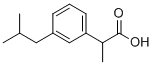
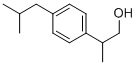
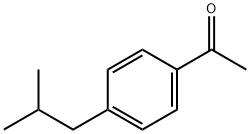
![2-[4-(1-METHYLPROPYL)PHENYL]PROPANOIC ACID](https://img.chemicalbook.com/StructureFile/ChemBookStructure9/GIF/CB6732396.gif)