Locust bean gum from Ceratonia siliqua seeds , 9000-40-2
Synonym(s):
Galactomannan polysaccharide;Gum, locust bean;Manno-galactan (main component)
CAS NO.:9000-40-2
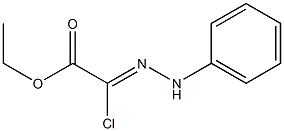
Empirical Formula: C10H11ClN2O2
Molecular Weight: 226.66
MDL number: MFCD00131257
EINECS: 232-541-5
| Pack Size | Price | Stock | Quantity |
| 100g | RMB66.40 | In Stock |
|
| 500G | RMB204.00 | In Stock |
|
| 1KG | RMB400.80 | In Stock |
|
| 5KG | RMB1876.00 | In Stock |
|
| others | Enquire |
PRODUCT Properties
| Melting point: | >200°C (dec.) |
| FEMA | 2648 | LOCUST GUM (CERATONIA SILIQUA L.) |
| storage temp. | Sealed in dry,Room Temperature |
| solubility | Ceratonia is dispersible in hot water, forming a sol
having a pH 5.4–7.0 that may be converted to a gel by the
addition of small amounts of sodium borate. In cold water,
ceratonia hydrates very slowly and incompletely. Ceratonia is
practically insoluble in ethanol. |
| form | Solid |
| color | Off-White to Light Beige |
| Odor | at 100.00 %. fruity raisin jammy brown cocoa chocolate bready coffee jammy brandy |
| Odor Type | fruity |
| biological source | Ceratonia siliqua seeds |
| Stability: | Hygroscopic |
| Cosmetics Ingredients Functions | SKIN CONDITIONING - EMOLLIENT VISCOSITY CONTROLLING FRAGRANCE BINDING FILM FORMING EMULSION STABILISING |
| Cosmetic Ingredient Review (CIR) | LOCUST BEAN GUM (9000-40-2) |
| InChI | InChI=1S/C10H11ClN2O2/c1-2-15-10(14)9(11)13-12-8-6-4-3-5-7-8/h3-7,12H,2H2,1H3/b13-9- |
| InChIKey | LZCJYKSOIZQABU-LCYFTJDESA-N |
| SMILES | C(OCC)(=O)/C(/Cl)=N/NC1=CC=CC=C1 |
| EPA Substance Registry System | Carob gum (9000-40-2) |
Description and Uses
Locust Bean Gum is a gum that is a galactomannan obtained from the plant seed from the locust bean tree known as ceratonia siliqua. it has a mannose:galactose ratio of approximately 4:1. its properties include swelling partially in cold water but requiring heating to approximately 82°c for complete solubility. it provides high viscos- ity, forms gels with xanthan gum upon heating and cooling of the solution, and functions as a water binder. it can make agar or car- rageenan gels more elastic. its uses include processed cheese, ice cream, bakery products, soups, and pies. typical usage level is 0.1– 1.0%. it is also called carob gum or saint john’s bread, and is scien- tifically called carubin.
Safety
| Symbol(GHS) |   GHS08,GHS02 |
| Signal word | Danger |
| Hazard statements | H226-H304 |
| PPE | Eyeshields, Gloves, type N95 (US) |
| WGK Germany | 2 |
| RTECS | OJ8690000 |
| F | 3 |
| TSCA | TSCA listed |
| Storage Class | 11 - Combustible Solids |
| Hazardous Substances Data | 9000-40-2(Hazardous Substances Data) |

![Tris(2,2,6,6-tetramethyl-3,5-heptanedionato)europium(III) [NMR Shift Reagent]](https://img.chemicalbook.com/CAS/GIF/15522-71-1.gif)