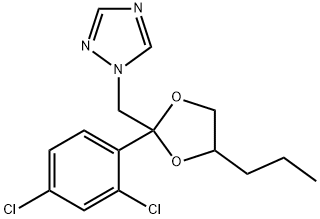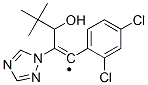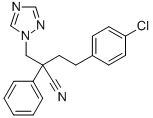
FenbuconazoleSolutioninMethanol , 100μg/mLinMethanol,uncertainty3% , 114369-43-6
CAS NO.:114369-43-6
Empirical Formula: C19H17ClN4
Molecular Weight: 336.82
MDL number: MFCD01632336
EINECS: 406-140-2
| Pack Size | Price | Stock | Quantity |
| 1.2ml | RMB63.20 | In Stock |
|
| others | Enquire |
PRODUCT Properties
| Melting point: | 125.0℃ |
| Boiling point: | 507.14°C (rough estimate) |
| Density | 1.1288 (rough estimate) |
| vapor pressure | 5 x l0-6 Pa (20 °C) |
| refractive index | 1.6110 (estimate) |
| storage temp. | 0-6°C |
| solubility | Chloroform (Slightly), DMSO (Slightly) |
| Water Solubility | 0.2 mg l-1 (25 °C) |
| pka | 2.34±0.10(Predicted) |
| Appearance | White to off-white Solid |
| BRN | 8333667 |
| Henry's Law Constant | 3.3×10⁴ mol/(m3Pa) at 25℃, Maniere et al. (2011) |
| Major Application | agriculture environmental |
| InChI | InChI=1S/C19H17ClN4/c20-18-8-6-16(7-9-18)10-11-19(12-21,13-24-15-22-14-23-24)17-4-2-1-3-5-17/h1-9,14-15H,10-11,13H2 |
| InChIKey | RQDJADAKIFFEKQ-UHFFFAOYSA-N |
| SMILES | C(C1C=CC=CC=1)(C#N)(CCC1C=CC(=CC=1)Cl)CN1N=CN=C1 |
| LogP | 3.79 at 20℃ |
| EPA Substance Registry System | Fenbuconazole (114369-43-6) |
Description and Uses
Fenbuconazole is a triazole fungicide with systemic, protectant and curative actions. It has a low aqueous solubility but is soluble in many organic solvents. It is not volatile. It can be persistent in both soil and water systems depending upon local conditions. Based on its physico-chemical properties, fenbuconazole is not expected to leach to groundwater. It is moderately toxic to most aquatic species as well as earthworms and honeybees. Oral toxicity is low but there are a few concerns regarding chronic toxicity.
Fenbuconazole is used for control of Septoria, Puccinia rusts, bunt, smut and Rhyncosporium secalis on cereals; powdery mildew and scab on pome fruit; brown rot and powdery mildew on stone fruit; powdery mildew, black rot and grey mould on vines, rust on beans and bean leaf spot on sugar beet. It is also used for control of a wide range of diseases on field crops, rice, bananas, tree nuts, vegetables and ornamentals. It can also be used in foliar, post-harvest and seed treatments.
Safety
| Symbol(GHS) |  GHS09 |
| Signal word | Warning |
| Hazard statements | H410 |
| Precautionary statements | P273-P391-P501 |
| PPE | dust mask type N95 (US), Eyeshields, Faceshields, Gloves |
| Hazard Codes | N |
| Risk Statements | 50/53 |
| Safety Statements | 60-61 |
| RIDADR | UN 3077 9/PG 3 |
| WGK Germany | 2 |
| RTECS | XZ5257500 |
| Storage Class | 11 - Combustible Solids |
| Hazard Classifications | Aquatic Acute 1 Aquatic Chronic 1 |
| Toxicity | LD50 in rats (mg/kg): >2000 orally; >5000 dermally (Driant) |
| REACH Registrations | Inactive |