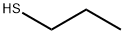
1-Propanethiol , 98% , 107-03-9
Synonym(s):
n-Propylmercaptan;1-PP;1-Propanethiol;Mercaptan C3;Propyl mercaptan
CAS NO.:107-03-9
Empirical Formula: C3H8S
Molecular Weight: 76.16
MDL number: MFCD00004900
EINECS: 203-455-5
PRODUCT Properties
| Melting point: | -113 °C |
| Boiling point: | 67-68 °C(lit.) |
| Density | 0.841 g/mL at 25 °C(lit.) |
| vapor density | 2.54 (vs air) |
| vapor pressure | 122 mm Hg ( 20 °C) |
| refractive index | n |
| FEMA | 3521 | PROPANETHIOL |
| Flash point: | −5 °F |
| storage temp. | Store below +30°C. |
| solubility | 1.9g/l |
| form | Liquid |
| pka | pK1:10.86 (25°C) |
| color | Colorless |
| Odor | at 0.10 % in propylene glycol. cabbage natural gas sweet onion |
| Odor Type | alliaceous |
| biological source | synthetic |
| Odor Threshold | 0.000013ppm |
| Water Solubility | immiscible |
| Specific Heat Capacity | Cp(liquid): 1.9 J/(g·K), at 25℃ |
| Sensitive | Air Sensitive |
| JECFA Number | 509 |
| BRN | 1696860 |
| Henry's Law Constant | 1.7×10⁻³ mol/(m3Pa) at 25℃, Plyasunova et al. (2004) |
| Exposure limits | NIOSH: Ceiling 0.5 ppm(1.6 mg/m3) |
| InChI | 1S/C3H8S/c1-2-3-4/h4H,2-3H2,1H3 |
| InChIKey | SUVIGLJNEAMWEG-UHFFFAOYSA-N |
| SMILES | CCCS |
| LogP | 1.7 at 20℃ |
| CAS DataBase Reference | 107-03-9(CAS DataBase Reference) |
| NIST Chemistry Reference | 1-Propanethiol(107-03-9) |
| EPA Substance Registry System | 1-Propanethiol (107-03-9) |
Description and Uses
Propane thiol is an organic compound with the molecular formula C3H8S. It belongs to the group of thiols. It is a colorless liquid with a strong, offensive odor. It is moderately toxic and is less dense than water and slightly soluble in water. It is used as a chemical intermediate and a herbicide . It is highly flammable and it gives off irritating or toxic fumes (or gases) in a fire. Heating it will cause rise in pressure with risk of bursting.
1-PP can be used as a capping agent that improves the thermal stability and light absorption of silver nanoparticles (AgNPs), which can be incorporated into the perovskite solar cells. Gallium-arsenic (Ga-As) can be surface functionalized with 1-PP and can be potentially used in the fabrication of group VI precusors and self-assembled electron beam resists in semiconductor industry. It can also form a SAM on gold(111) surface that may be used to immobilize macromolecules.
Safety
| Symbol(GHS) |    GHS02,GHS07,GHS09 |
| Signal word | Danger |
| Hazard statements | H302-H333-H315-H319-H335-H410-H225 |
| Precautionary statements | P501-P261-P273-P270-P240-P210-P233-P243-P241-P242-P271-P264-P280-P370+P378-P391-P337+P313-P305+P351+P338-P362+P364-P303+P361+P353-P332+P313-P301+P312+P330-P304+P340+P312-P403+P233-P403+P235-P405 |
| PPE | Eyeshields, Faceshields, Gloves, type ABEK (EN14387) respirator filter |
| Hazard Codes | F,Xn,N |
| Risk Statements | 11-22-37/38-41-50-36/37/38-21/22 |
| Safety Statements | 16-26-39-57-36/37/39-29 |
| OEL | Ceiling: 0.5 ppm (1.6 mg/m3) [15-minute] |
| RIDADR | UN 2402 (PROPANETHIOLS) |
| WGK Germany | 3 |
| RTECS | TZ7300000 |
| F | 13 |
| TSCA | TSCA listed |
| HazardClass | 3 |
| PackingGroup | II |
| HS Code | 29309070 |
| Storage Class | 3 - Flammable liquids |
| Hazard Classifications | Acute Tox. 4 Oral Aquatic Acute 1 Aquatic Chronic 1 Flam. Liq. 2 Skin Sens. 1B |
| Hazardous Substances Data | 107-03-9(Hazardous Substances Data) |
| Toxicity | LD50 orally in Rabbit: 1790 mg/kg |
| REACH Registrations | Active |
| Limited Quantities | 1.0 L (0.3 gallon) (liquid) |
| Excepted Quantities | Max Inner Pack (30g or 30ml) and Max Outer Pack (500g or 500ml) |