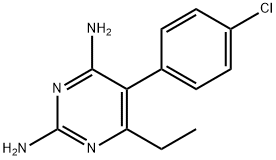
Pyrimethamine , Analysis standard , 58-14-0
Synonym(s):
5-(4-Chlorophenyl)-6-ethyl-2,4-pyrimidinediamine;Pyrimethamine
CAS NO.:58-14-0
Empirical Formula: C12H13ClN4
Molecular Weight: 248.71
MDL number: MFCD00057350
EINECS: 200-364-2
| Pack Size | Price | Stock | Quantity |
| 250MG | RMB79.20 | In Stock |
|
| 5G | RMB142.40 | In Stock |
|
| others | Enquire |
PRODUCT Properties
| Melting point: | 233-234°C |
| Boiling point: | 393.35°C (rough estimate) |
| Density | 1.2171 (rough estimate) |
| refractive index | 1.6110 (estimate) |
| storage temp. | Keep in dark place,Inert atmosphere,Room temperature |
| solubility | Prepare the solution immediately before use. Dissolve 0.25 g in a mixture of 1 volume of methanol R and 3 volumes of methylene chloride R and dilute to 10 mL with the same mixture of solvents. The solution is clear (2.2.1) and not more intensely coloured than reference solution BY6 (2.2.2, Method II). |
| pka | pKa 7(t=20.0) (Uncertain) |
| form | Solid |
| color | White to Off-White |
| Water Solubility | <0.01 g/100 mL at 21 ºC |
| λmax | 276nm(lit.) |
| Merck | 14,7985 |
| BRN | 219864 |
| Henry's Law Constant | 9.1×10⁴ mol/(m3Pa) at 25℃, HSDB (2015) |
| BCS Class | 2 (CLogP), 4
(LogP),3 |
| Stability: | Stable, but light sensitive. Combustible. Incompatible with strong oxidizing agents. |
| Major Application | clinical testing |
| InChI | 1S/C12H13ClN4/c1-2-9-10(11(14)17-12(15)16-9)7-3-5-8(13)6-4-7/h3-6H,2H2,1H3,(H4,14,15,16,17) |
| InChIKey | WKSAUQYGYAYLPV-UHFFFAOYSA-N |
| SMILES | CCC1=NC(N)=NC(N)=C1C2=CC=C(Cl)C=C2 |
| CAS DataBase Reference | 58-14-0(CAS DataBase Reference) |
| IARC | 3 (Vol. 13, Sup 7) 1987 |
| NIST Chemistry Reference | Pyrimethamine(58-14-0) |
| EPA Substance Registry System | Pyrimethamine (58-14-0) |
Description and Uses
For the treatment of toxoplasmosis and acute malaria; For the prevention of malaria in areas non-resistant to pyrimethamine.
Pyrimethamine is a dihydrofolate reductase inhibitor, like the biguanides, and is structurally related to trimethoprim. It is seldom used alone. Pyrimethamine in fixed combinations with dapsone or sulfadoxine is used for treatment and prophylaxis of chloroquine-resistant falciparum malaria. The synergistic activities of pyrimethamine and sulfonamides are similar to those of trimethoprim/sulfonamide combinations. Resistant strains of Plasmodium falciparum have appeared world wide. Prophylaxis against falciparum malaria with pyrimethamine alone is therefore not recommended. Most strains of Plasmodium vivax have remained sensitive. Pyrimethamine is also used in combination with a sulfonamide for the treatment of Toxoplasmosis. It is slowly absorbed from the gastrointestinal tract with peak plasma levels 4–6 hours after dosing. Pyrimethamine is bound to plasma proteins and is extensively metabolized before excretion. Its elimination half-life is 3–5 days.
Safety
| Symbol(GHS) |  GHS07 |
| Signal word | Warning |
| Hazard statements | H302 |
| Precautionary statements | P264-P270-P301+P312-P501 |
| PPE | dust mask type N95 (US), Eyeshields, Faceshields, Gloves |
| Hazard Codes | Xn |
| Risk Statements | 22-36 |
| Safety Statements | 26 |
| RIDADR | 3249 |
| WGK Germany | 3 |
| RTECS | UV8140000 |
| HazardClass | 6.1(b) |
| PackingGroup | III |
| HS Code | 29335990 |
| Storage Class | 11 - Combustible Solids |
| Hazard Classifications | Acute Tox. 4 Oral |
| Hazardous Substances Data | 58-14-0(Hazardous Substances Data) |
| Toxicity | LD50 oral in rat: 440mg/kg |