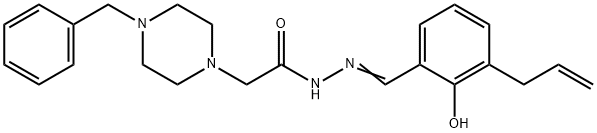
A6811012
PAC-1 , ≥98% , 315183-21-2
Synonym(s):
(4-Benzylpiperazino)acetic acid (3-allyl-2-hyroxybenzylidene)hydrazide;1-Piperazineacetic acid, 2-(phenylmethyl)-,[[2-hydroxy-3-(2-propenyl)phenyl]methylene]hyrrazide;Dual specificity protein phosphatase 2;Dual specificity protein phosphatase PAC-1;DUSP2
| Pack Size | Price | Stock | Quantity |
| 10MG | RMB367.20 | In Stock |
|
| 50MG | RMB1007.20 | In Stock |
|
| others | Enquire |
Update time: 2022-07-08
PRODUCT Properties
| Density | 1.14 |
| storage temp. | Store at +4°C |
| solubility | DMSO: ≥10mg/mL |
| form | solid |
| pka | 8.82±0.40(Predicted) |
| color | white |
| Stability: | Stable for 1 year from date of purchase as supplied. Solutions in DMSO or ethanol must be stored under inert gas at -80°C and will be stable for up to 2 months. |
| InChI | 1S/C23H28N4O2/c1-2-7-20-10-6-11-21(23(20)29)16-24-25-22(28)18-27-14-12-26(13-15-27)17-19-8-4-3-5-9-19/h2-6,8-11,16,29H,1,7,12-15,17-18H2,(H,25,28)/b24-16+ |
| InChIKey | YQNRVGJCPCNMKT-LFVJCYFKSA-N |
| SMILES | Oc1c(CC=C)cccc1\C=N\NC(=O)CN2CCN(CC2)Cc3ccccc3 |
Description and Uses
PAC-1 (315183-21-2) is a procaspase-activating compound, directly activating procaspase-3, producing caspase-3, EC50=0.22 μM.1 It is less potent at activating procaspase-7, EC50=4.5 μM. It induces apoptosis in a variety of cancer cell lines. The mechanism of activation involves sequestering inhibitory zinc ions thus allowing procaspase-3 to autoactivate.2 Sensitizes cancer cells to various chemotherapeutic agents.3
PAC-1 is a potent procaspase-3 activator with EC50 of 0.22 μM.
Safety
| Symbol(GHS) |   GHS07,GHS09 |
| Signal word | Warning |
| Hazard statements | H302-H315-H319-H335-H400 |
| Precautionary statements | P261-P273-P305+P351+P338 |
| PPE | dust mask type N95 (US), Eyeshields, Gloves |
| Hazard Codes | Xn,N |
| Risk Statements | 22-36/37/38-50/53 |
| Safety Statements | 26-36/37-60-61 |
| RIDADR | UN 3077 |
| WGK Germany | 3 |
| HS Code | 29335990 |
| Storage Class | 11 - Combustible Solids |