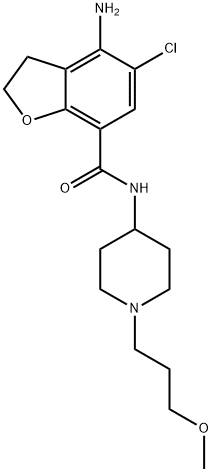
Prucalopride , ≥99% , 179474-81-8
Synonym(s):
4-Amino-5-chloro-2,3-dihydro-N-[1-(3-methoxypropyl)-4-piperidinyl]-7-benzofurancarboxamide
CAS NO.:179474-81-8
Empirical Formula: C18H26ClN3O3
Molecular Weight: 367.87
MDL number: MFCD09837787
EINECS: 1312995-182-4
| Pack Size | Price | Stock | Quantity |
| 10MG | RMB445.60 | In Stock |
|
| 50MG | RMB576.00 | In Stock |
|
| others | Enquire |
PRODUCT Properties
| Melting point: | 90.7° |
| Boiling point: | 481.4±45.0 °C(Predicted) |
| Density | 1.28 |
| storage temp. | 2-8°C |
| solubility | DMF: 20 mg/ml; DMF:PBS (pH 7.2) (1:9): 0.1 mg/ml; DMSO: 10 mg/ml; Ethanol: 10 mg/ml |
| form | powder |
| pka | 13.65±0.20(Predicted) |
| color | white to beige |
| InChI | InChI=1S/C18H26ClN3O3/c1-24-9-2-6-22-7-3-12(4-8-22)21-18(23)14-11-15(19)16(20)13-5-10-25-17(13)14/h11-12H,2-10,20H2,1H3,(H,21,23) |
| InChIKey | ZPMNHBXQOOVQJL-UHFFFAOYSA-N |
| SMILES | O1C2=C(C(NC3CCN(CCCOC)CC3)=O)C=C(Cl)C(N)=C2CC1 |
Description and Uses
Prucalopride is a potent and selective agonist of the serotonin (5-HT) receptor subtype 5-HT4 (Kis = 2.5 and 8 nM for human 5-HT4A and 5-HT4B, respectively). Prucalopride is greater than 250-fold selective for 5-HT4 over a panel of 53 overexpressed receptors, including 5-HT subtypes, but does bind to human dopamine D4 and sigma-1 (σ1) receptors and mouse 5-HT3 receptors (Kis = 2.3, 3.7, and 3.8 μM, respectively). It induces contractions in guinea pig colon with an EC50 value of 33 nM, an effect that is blocked by the 5-HT4 antagonist GR113808 but not the 5-HT2A and 5-HT3 antagonists ketanserin and granisetron , respectively. It also facilitates non-cholinergic contractions induced by electrical stimulation. In fasted dogs, oral administration of prucalopride increases colonic motility by inhibiting distal colon contractions (ED50 = 0.04 mg/kg), an effect that is blocked by pretreatment with the 5-HT4 antagonist GR125487. Prucalopride (5-10 mg/kg, s.c.) increases acetylcholine and histamine levels in the rat prefrontal cortex by 2.4-fold and 3-fold, respectively, and increases the power of hippocampal theta oscillations. Formulations containing prucalopride have been used in the treatment of chronic idiopathic constipation.
Prucalopride is a highly selective serotonin 5-HT4 receptor agonist and dihydrobenzofurancarboxamide derivative with gastrointestinal prokinetic activity. It is indicated for the treatment of laxative-resistant chronic idiopathic constipation and is available as oral tablets in strengths of 0.5, 1, 2, and 4 mg[2][3][4]. In patients with chronic idiopathic constipation, prucalopride improves colonic motility by stimulating high-amplitude propagating contractions, thereby decreasing colonic transit time and increasing the frequency of complete spontaneous bowel movements. Clinical trials have demonstrated that daily doses of 2 mg or 4 mg significantly accelerate gastric emptying, small bowel transit, and whole-gut transit compared with placebo, with 2 mg once daily showing comparable efficacy to 4 mg once daily[3][4][5]. Prucalopride has been shown to improve gastric emptying half-time in patients with idiopathic gastroparesis and restore normal bowel function in subgroups of difficult-to-treat patients. The drug does not interact with hERG potassium channels or 5-HT1B receptors, and administration at doses up to 10 mg daily has not resulted in QTcF prolongation. Common adverse events include nausea, vomiting, diarrhea, and headache, which are reported more frequently than with placebo but are typically mild to moderate[2][3][5].
Safety
| Symbol(GHS) |   GHS07,GHS09 |
| Signal word | Warning |
| Hazard statements | H315-H319-H335-H400 |
| Precautionary statements | P273-P302+P352-P305+P351+P338 |
| target organs | Respiratory system |
| RIDADR | UN 3077 9 / PGIII |
| WGK Germany | WGK 3 |
| Storage Class | 11 - Combustible Solids |
| Hazard Classifications | Aquatic Acute 1 Eye Irrit. 2 Skin Irrit. 2 STOT SE 3 |