
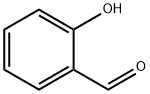
Salicylaldehyde , AR,98% , 90-02-8
Synonym(s):
2-Hydroxybenzaldehyde;Salicylaldehyde
CAS NO.:90-02-8
Empirical Formula: C7H6O2
Molecular Weight: 122.12
MDL number: MFCD00003317
EINECS: 201-961-0
PRODUCT Properties
| Melting point: | −7 °C (19 °F; 266 K) |
| Boiling point: | 196 to 197 °C (385 to 387 °F; 469 to 470 K) |
| Density | 1.146 g/cm3 |
| vapor density | 4.2 (vs air) |
| vapor pressure | 1 mm Hg ( 33 °C) |
| refractive index | 1.57 |
| FEMA | 3004 | SALICYLALDEHYDE |
| Flash point: | 90 °C |
| storage temp. | -20°C |
| solubility | 4.9g/l |
| pka | 8.37(at 25℃) |
| form | clear liquid |
| color | Colorless to Light yellow to Light orange |
| PH | 6-8 (H2O, 20℃)Not applicable |
| Odor | Bitter almonds |
| Odor Type | medicinal |
| biological source | synthetic |
| Water Solubility | slightly soluble |
| Specific Heat Capacity | Cp(liquid): 1.82 J/(g·K), at 25℃ |
| Sensitive | Air & Light Sensitive |
| Merck | 14,8326 |
| JECFA Number | 897 |
| BRN | 471388 |
| Henry's Law Constant | 1.1×100 mol/(m3Pa) at 25℃, Ji et al. (2008) |
| Exposure limits | ACGIH: TWA 5 ppm (Skin) OSHA: TWA 5 ppm(19 mg/m3) NIOSH: IDLH 250 ppm; TWA 5 ppm(19 mg/m3); Ceiling 15.6 ppm(60 mg/m3) |
| Dielectric constant | 13.9(20℃) |
| Stability: | Stable. Combustible. Incompatible with strong bases, strong reducing agents, strong acids, strong oxidizing agents. |
| Cosmetics Ingredients Functions | FRAGRANCE |
| InChI | 1S/C7H6O2/c8-5-6-3-1-2-4-7(6)9/h1-5,9H |
| InChIKey | SMQUZDBALVYZAC-UHFFFAOYSA-N |
| SMILES | Oc1ccccc1C=O |
| LogP | 1.66 at 25℃ and pH6.2-6.3 |
| CAS DataBase Reference | 90-02-8(CAS DataBase Reference) |
| NIST Chemistry Reference | Benzaldehyde, 2-hydroxy-(90-02-8) |
| EPA Substance Registry System | Salicylaldehyde (90-02-8) |
Description and Uses
Salicylaldehyde (2-hydroxybenzaldehyde) is an organic compound with the formula C6H4CHO-2-OH. Along with 3-hydroxybenzaldehyde and 4-hydroxybenzaldehyde, it is one of the three isomers of hydroxybenzaldehyde. It is a colorless or pale yellow liquid with a bitter almond odor and a burning taste. It is soluble in alcohol, benzene, and ether, and very slightly soluble in water. Salicylaldehyde is found in shrubs of the genus Spiraea and is usually produced from phenol by the action of chloroform in the presence of an alkali base. It is used in the production of coumarin, saligenin, and salicylaldoxime (an important analytical reagent), and also in analytical chemistry—for example, to detect hydrazine. Besides, salicylaldehyde is a key precursor to various chelating agents and a flavouring ingredient.
Salicylaldehyde, is used as flavor and fragrance components. Salicylaldehyde is also a common highly-functionalized arene, that can be used as a precursor in the synthesis of other chemicals.
Safety
| Symbol(GHS) |   GHS06,GHS08 |
| Signal word | Danger |
| Hazard statements | H311-H302-H315-H361-H371-H373-H401-H412-H227 |
| Precautionary statements | P501-P273-P260-P270-P202-P210-P201-P264-P280-P370+P378-P308+P311-P361+P364-P332+P313-P301+P312+P330-P302+P352+P312-P403+P235-P405 |
| PPE | Faceshields, Gloves, Goggles, type ABEK (EN14387) respirator filter |
| Hazard Codes | Xn,N |
| Risk Statements | 21/22-36/38-68-36/37/38-20/21/22-51-36-51/53-22 |
| Safety Statements | 26-36/37-36/37/39-36-61-64-29/35 |
| RIDADR | 3082 |
| WGK Germany | 2 |
| RTECS | VN5250000 |
| F | 8-10-23 |
| TSCA | TSCA listed |
| HazardClass | 6.1(b) |
| PackingGroup | II |
| HS Code | 29122990 |
| Storage Class | 11 - Combustible Solids |
| Hazard Classifications | Acute Tox. 4 Oral Aquatic Chronic 2 Eye Irrit. 2 Muta. 2 Skin Irrit. 2 |
| Hazardous Substances Data | 90-02-8(Hazardous Substances Data) |
| Toxicity | MLD in rats (mg/kg): 900-1000 s.c. (Binet) |
| REACH Registrations | Active |
| Excepted Quantities | Non-Hazardous |

