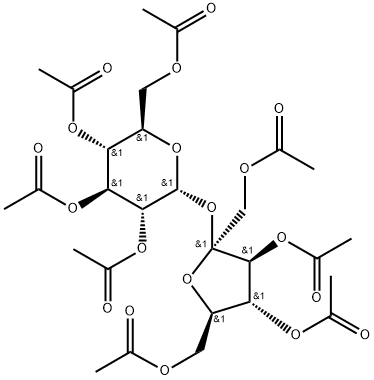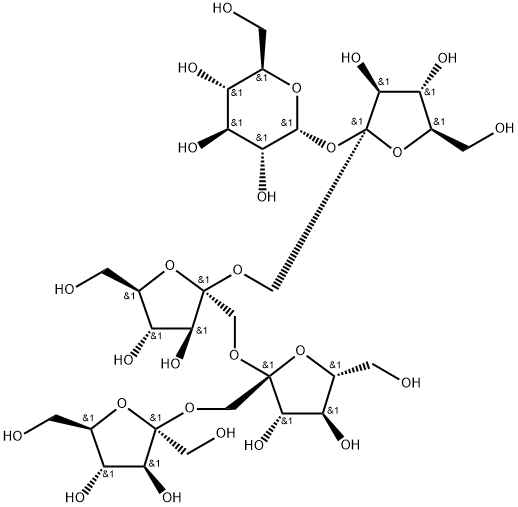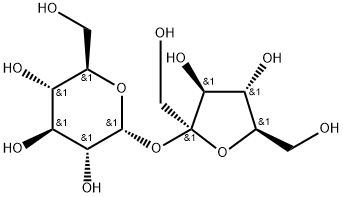
Sucrose , For cell or insect cell culture, ≥99.5% , 57-50-1
Synonym(s):
Sucrose;Sugar;α-D -Glc-(1→2)-β-D -Fru;α-D -Glucopyranosyl β-D -fructofuranoside;β-D -Fructofuranosyl-α-D -glucopyranoside
CAS NO.:57-50-1
Empirical Formula: C12H22O11
Molecular Weight: 342.3
MDL number: MFCD00006626
EINECS: 200-334-9
| Pack Size | Price | Stock | Quantity |
| 500G | RMB159.20 | In Stock |
|
| 1KG | RMB238.40 | In Stock |
|
| 5KG | RMB784.00 | In Stock |
|
| others | Enquire |
PRODUCT Properties
| Melting point: | 185-187 °C (lit.) |
| Boiling point: | 397.76°C (rough estimate) |
| alpha | 67 º (c=26, in water 25 ºC) |
| Density | 1.5805 |
| bulk density | 800-950kg/m3 |
| refractive index | 66.5 ° (C=26, H2O) |
| Flash point: | 93.3°C |
| storage temp. | Inert atmosphere,Room Temperature |
| solubility | H2O: 500 mg/mL |
| form | Liquid |
| pka | 12.7(at 25℃) |
| color | White |
| PH | 5.0-7.0 (25℃, 1M in H2O) |
| Odor | Odorless |
| PH Range | 5.5 - 7 at 342 g/l at 25 °C |
| optical activity | [α]25/D +66.3 to +66.8°(lit.) |
| biological source | sugar cane |
| Water Solubility | 1970 g/L (15 ºC) |
| λmax | λ: 260 nm Amax: 0.11 λ: 280 nm Amax: 0.08 |
| Merck | 14,8881 |
| BRN | 90825 |
| Exposure limits | ACGIH:TLV-TWA 10 mg/m3 OSHA:PEL-TWA 15 mg/m3 (total dust),5 mg/m3 (respirable fraction) NIOSH:REL-TWA 10 mg/m3 (total dust),5 mg/m3 (respirable fraction) |
| Dielectric constant | 3.3(Ambient) |
| Stability: | Stable. Combustible. Incompatible with strong oxidizing agents. Hydrolyzed by dilute acids and by invertase. |
| Cosmetics Ingredients Functions | HUMECTANT SKIN CONDITIONING SOOTHING |
| InChI | 1S/C12H22O11/c13-1-4-6(16)8(18)9(19)11(21-4)23-12(3-15)10(20)7(17)5(2-14)22-12/h4-11,13-20H,1-3H2/t4-,5-,6-,7-,8+,9-,10+,11-,12+/m1/s1 |
| InChIKey | CZMRCDWAGMRECN-UGDNZRGBSA-N |
| SMILES | OC[C@H]1O[C@H](O[C@]2(CO)O[C@H](CO)[C@@H](O)[C@@H]2O)[C@H](O)[C@@H](O)[C@@H]1O |
| LogP | -4.492 (est) |
| CAS DataBase Reference | 57-50-1(CAS DataBase Reference) |
| NIST Chemistry Reference | Sucrose(57-50-1) |
| EPA Substance Registry System | Sucrose (57-50-1) |
| Absorption | ≤0.100 at 280nm ≤0.120 at 260nm |
Description and Uses
Saccharum is the Latin word for sugar and the derived term saccharide
is the basis of a system of carbohydrate classification. The simplest
sugars belong to the carbohydrate class, monosaccharide; they include
fructose and glucose.
Hydrolysis of sucrose yields D-glucose and D-fructose; the process is
called inversion and the sugar mixture produced is known as invert
sugar because, although sucrose itself rotates plane-polarized light to the
right, the mixture inverts this light by rotating to the left.
The carbohydrate class, polysaccharide, represents compounds in
which the molecules contain many units of monosaccharides joined
together by glycoside links. Upon complete hydrolysis, a polysaccharide
yields monosaccharides. Starch is the most valuable polysaccharide.
The starch molecules (amylose and anylopectin) are tree-like, containing
250 to 1000 or more glucose units per molecule joined together
through alpha linkages.
In commercial usage, the term sugar usually refers to sucrose. Sucrose
is a disaccharide sugar that occurs naturally in every fruit and vegetable.
It is a major product of photosynthesis, the process by which
plants transform the energy of the sun into food. Sugar occurs in greatest
quantities in sugarcane and sugar beets from which it is separated
for commercial use.
Safety
| Symbol(GHS) |  GHS07 |
| Signal word | Warning |
| Hazard statements | H315-H319-H335 |
| Precautionary statements | P261-P271-P280 |
| Hazard Codes | Xi |
| Risk Statements | 36/37/38 |
| Safety Statements | 24/25-37/39-26 |
| OEB | B |
| OEL | TWA: 10 mg/m3 (total) |
| WGK Germany | 2 |
| RTECS | WN6500000 |
| F | 3 |
| TSCA | TSCA listed |
| HS Code | 17019910 |
| Storage Class | 11 - Combustible Solids |
| Hazardous Substances Data | 57-50-1(Hazardous Substances Data) |
| Toxicity | LD50 orally in Rabbit: 29700 mg/kg |